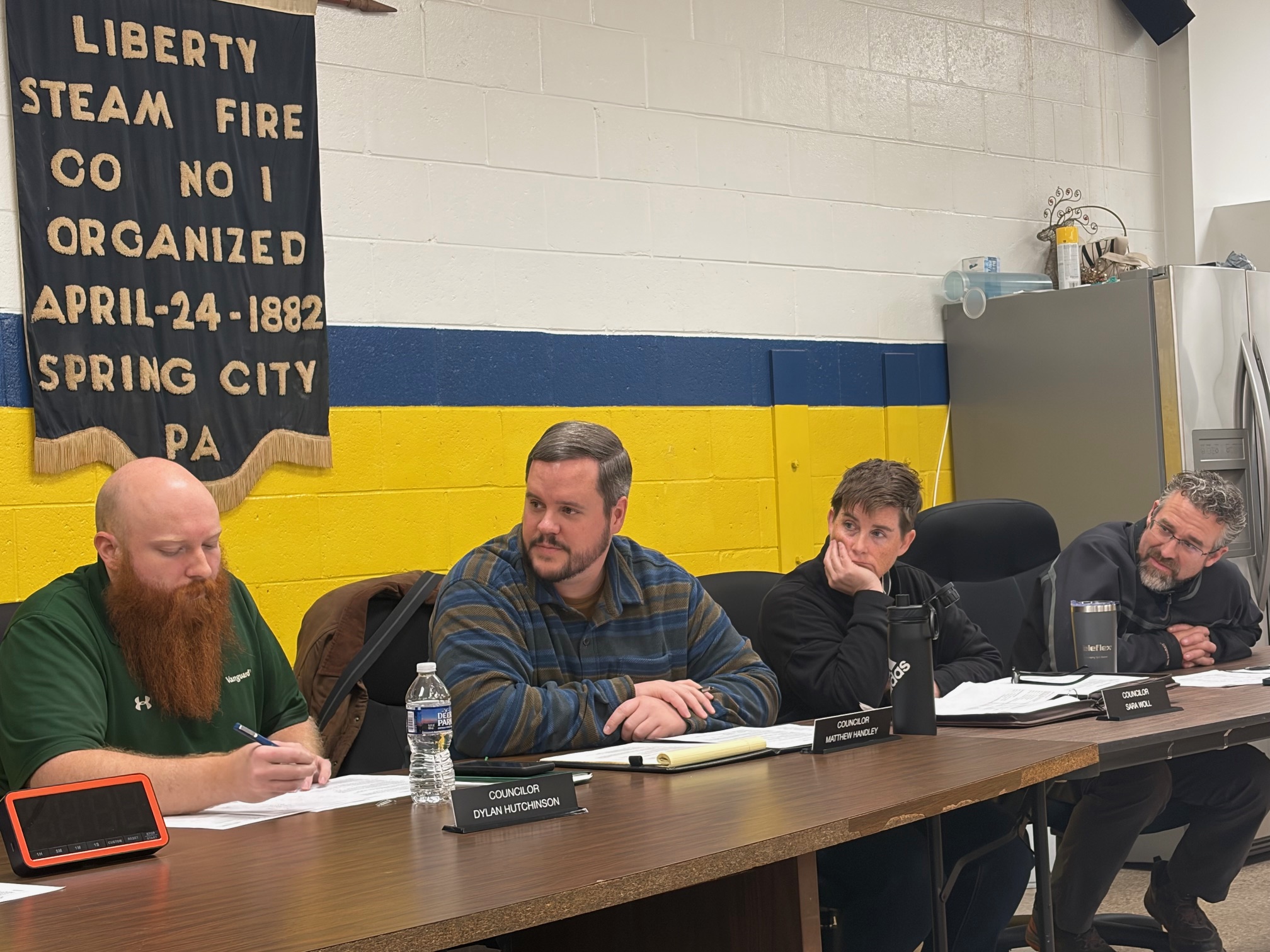
Spring City Borough residents could see their first municipal property tax increase in six years as borough council considers raising additional revenue to address rising operating costs and infrastructure needs.
During their Monday, November 2, meeting, council members reviewed a proposed 2027 budget that would maintain the current property tax rate. However, several members expressed concerns about the borough's continued reliance on reserve funds and pushed to keep the possibility of a tax increase on the table.
The discussion led to an unusual moment when Councilor Rick Pennypacker, who was presiding over the meeting in the absence of Council President Don Shaner and Vice President Chris Yocum, made a motion to advance the proposed budget without a tax increase.
None of the four other council members present — Dylan Hutchinson, Matt Handley, Sara Woll, or Brandon Woll — seconded the motion.
"No. So I guess we're gonna raise taxes," Pennypacker said after receiving no second.
"It doesn't necessarily mean we're going to raise taxes," Brandon Woll responded. "It means we're going to investigate."
Council ultimately voted to advertise the proposed budget for public review and, in a separate motion, authorized advertising a tax ordinance with a maximum rate of 6 mills. The current rate is 5.18 mills.
No tax increase has been approved. The advertised rate establishes a ceiling, allowing council to consider a smaller increase or maintain the existing rate when it takes up the matter again in December.
Rising Costs and Reserve Funds
Borough Manager Kisha Tyler presented a proposed 2027 general fund budget of $4,328,250, with projected revenues matching expenditures. The proposal includes $300,000 in transfers from capital reserves.
A separate sewer operating budget totals $1,549,800, including a $250,000 transfer from sewer reserves.
Tyler explained that some reserve funds have already been committed to construction of the borough's new municipal building. However, council members also raised concerns about relying on savings to address other expenses.
Hutchinson noted that the borough has not increased its property tax rate since 2020, despite inflation and rising municipal costs. He suggested that previous councils bear some responsibility for the borough's current financial challenges by keeping taxes unchanged for six years, even as expenses continued to rise.
Handley and the Wolls were elected to the seven-member council in 2025, and Hutchinson was appointed to fill a vacancy earlier this year.
Hutchinson also pointed to the borough's aging stormwater infrastructure, including deteriorating underground pipes along Main Street. The proposed budget allocates $250,000 for stormwater management, and officials are exploring grant opportunities to help cover the repairs.
Tyler acknowledged that a tax increase would eventually become necessary to maintain borough services as costs continue to rise.
She emphasized that any increase would not be intended to pay for the new municipal building, explaining that interest earnings are currently sufficient to cover the annual bond payment.
Instead, additional tax revenue would help address ordinary expenses, including road paving, personnel costs, and other municipal operations.
Handley suggested that the borough may have reached the point where an increase is necessary.
"I don't want to raise taxes as much as the next person," Handley said, noting that he is also a borough homeowner. "But I think the time might have already reached us."
He argued that keeping taxes unchanged while repeatedly drawing from reserves was not a sustainable long-term approach.
"We're doing a lot with a little here," Handley said, citing the borough's efforts to maintain roads, sewers, stormwater infrastructure, and other public services.
Police Spending Draws Questions
Police spending also received scrutiny during the budget review, with council members questioning Police Chief Ryan White about proposed expenditures.
Handley sought clarification about police staffing, including the department's use of part-time officers. Hutchinson separately questioned a requested increase in funding for police administration from approximately $24,000 to $47,000.
As the questioning continued, Mayor Adam Alberico expressed concern about the direction of the discussion.
"There's been a lot of questions regarding the police," Alberico said. "Is the council looking to cut the police budget?"
Alberico, who oversees the borough's police department, explained that he wanted to ensure officers had adequate resources while acknowledging council's history of supporting the department.
Handley responded that asking questions was part of his nature as an attorney, while Brandon Woll clarified that he was not proposing any reduction in police funding.
Tyler subsequently explained that the proposed budget allocates $898,770 for police and public safety, along with $110,000 for fire and emergency services. She said the borough has worked to improve police salaries and reduce turnover while keeping expenditures manageable.
"Those numbers that we presented are probably as low as I can go," Tyler said.
How Much Could Taxes Increase?
Although Tyler's proposed budget does not include a property tax increase, council members discussed several possible scenarios.
Hutchinson suggested that a rate of 5.7 to 5.75 mills could provide additional revenue without imposing an excessive burden on residents.
He estimated that increasing the rate to 5.75 mills would cost a typical borough homeowner roughly $50 more annually. Based on the borough's current rate of 5.18 mills, that would represent an increase of roughly 11 percent in municipal property taxes.
For example, a homeowner whose property is assessed at $100,000 currently pays $518 annually in borough property taxes at the existing rate of 5.18 mills.
If the rate increased to 5.75 mills, that homeowner would pay $575 annually, an increase of $57. At the maximum proposed rate of 6 mills, the annual bill would rise to $600, an increase of $82.
These figures apply only to borough property taxes and do not include taxes collected by Chester County or the Spring-Ford Area School District. A property's assessed value is also different from its current market value.
Hutchinson acknowledged that many residents are already struggling with rising household expenses, including heating costs, and said he did not favor a substantially larger increase.
However, he also questioned whether the borough could continue withdrawing hundreds of thousands of dollars from reserves each year.
"It's just not a sustainable practice," Hutchinson said.
Handley estimated that completely eliminating the borough's reliance on reserve transfers could require raising the millage rate to approximately 8.7 mills, a figure he said would be too high.
The council instead agreed to advertise an ordinance allowing a maximum rate of 6 mills, providing flexibility while additional financial analysis is completed.
What Happens Next?
Borough Solicitor Matthew Hovey explained that the borough must advertise a proposed tax increase before adopting it. The advertised rate must be at least as high as the rate council ultimately intends to approve.
By advertising an ordinance with a 6-mill ceiling, council can continue evaluating its options without having to restart the public notice process if members decide an increase is warranted.
Following the discussion, Hutchinson made a motion to authorize public advertisement of the proposed 2027 budget. Council approved the motion unanimously.
Hutchinson then made a separate motion to advertise the tax ordinance with a 6-mill ceiling. The motion passed 4-1, with Pennypacker casting the lone dissenting vote.
The proposed budget is available for public inspection before council's next meeting on Monday, December 7, at 6:30 p.m.
Council members are expected to revisit the millage rate at that meeting and determine whether to move forward with a tax increase.
Brandon Woll indicated later during Monday's meeting that he intends to continue reviewing the proposed expenditures for potential savings before making a final decision.
"I too would rather not raise taxes," he said. "I want to keep digging into the budget and see what else we can trim, if there's anything we can do there."