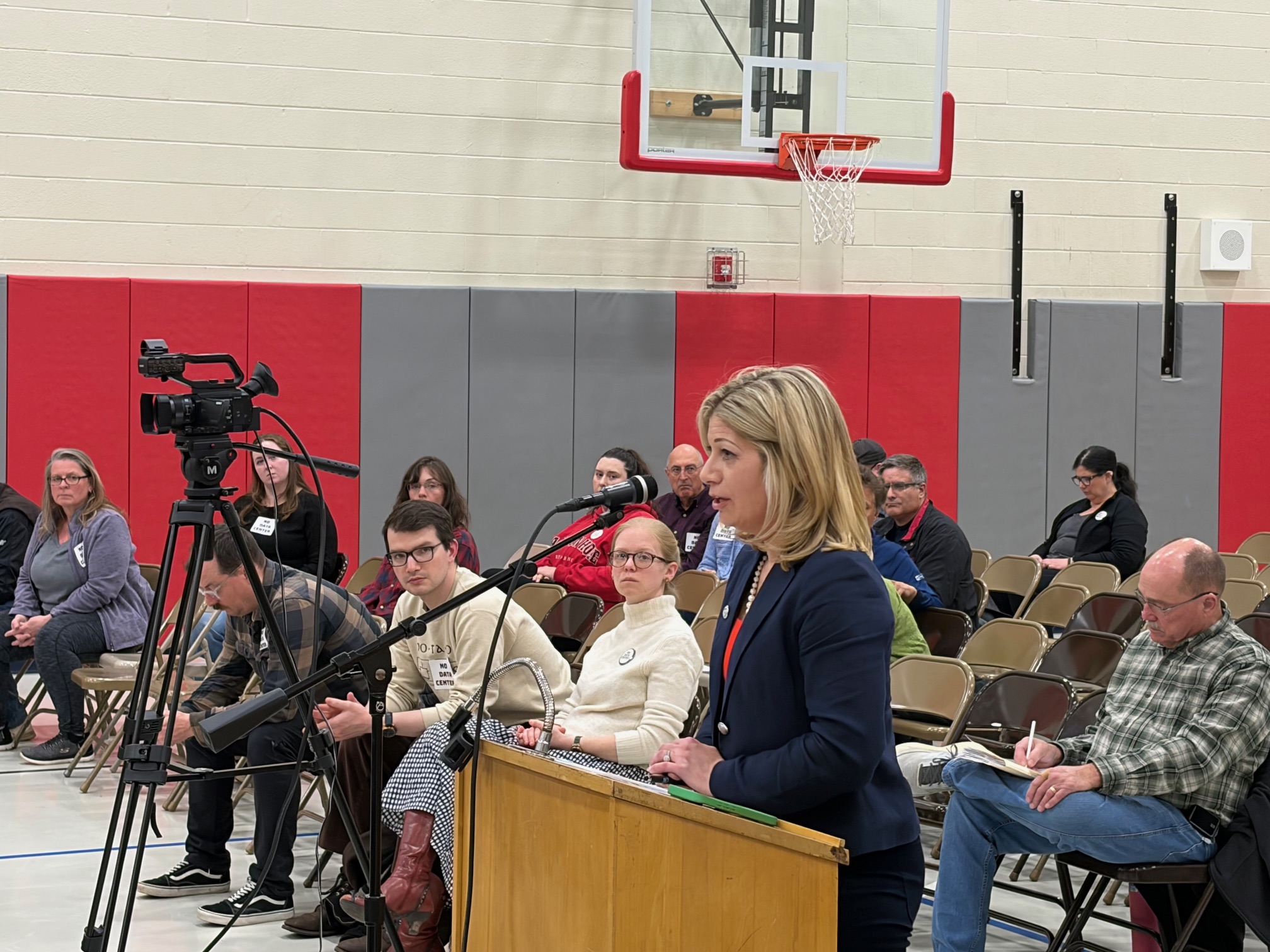
When State Sen. Katie Muth spoke with Spring-Ford Press on Monday, she had just finished a conversation with a sound expert about the low-frequency noise associated with hyperscale data centers.
It was the latest in her ongoing effort to understand the potential health and environmental impacts of the massive facilities being proposed throughout Pennsylvania, particularly in southeastern communities where residential development often sits alongside industrial properties.
For Muth, one of the state's most outspoken opponents of hyperscale data center development, the issue has become about much more than noise, water consumption, or electricity demand. She believes Pennsylvania's approach to land use has exposed deeper problems involving corporate influence, political accountability, and the legal advice local governments receive.
The Democratic senator, first elected in 2018, is seeking a third term representing Pennsylvania's 44th Senate District. She faces Republican challenger Melissa Dicranian in the November 3 general election.
During a wide-ranging Zoom interview, Muth discussed her opposition to data center development, her concerns about Pennsylvania's political and legal systems, and her efforts to encourage residents to become more involved in government decisions.
The 44th District encompasses portions of Chester, Montgomery, and Berks counties, including Spring City, Royersford, Phoenixville, East Vincent, and Upper Providence.
From Fracking to Data Centers
Muth traces her concerns about data centers partly to her earlier work opposing industrial pollution, particularly from Pennsylvania's oil and gas industry.
Originally from Westmoreland County in western Pennsylvania, she said her experiences with fracking, pipelines, and the health effects of industrial activity helped shape her approach to the state's emerging data center industry.
She believes Pennsylvania has become an especially attractive destination for developers because of its natural gas reserves, extensive pipeline and electrical infrastructure, and abundant water resources.
For Muth, the industry's expansion represents another example of what she considers the state's longstanding tendency to prioritize industrial development over residents' well-being.
"That's the problem with Pennsylvania," she said. "It's always been industry first."
The issue also became personal after she moved to East Vincent Township in 2023. The township is home to one of the region's most controversial proposals: a 1.9-million-square-foot hyperscale data center planned for the former Pennhurst State School and Hospital property near the Schuylkill River.
East Vincent supervisors unanimously denied the developer's conditional use application in May, but Penn Hurst Holdings has appealed the decision in Chester County Court. Those proceedings are scheduled to begin November 10.
Muth believes that development could have consequences extending far beyond East Vincent. She argues that hyperscale data centers tend to develop in clusters, making the approval of one large facility potentially attractive to other developers seeking nearby properties.
"East Vincent Township cannot be the domino to fall," she said, warning that approval could encourage additional development throughout the surrounding region.
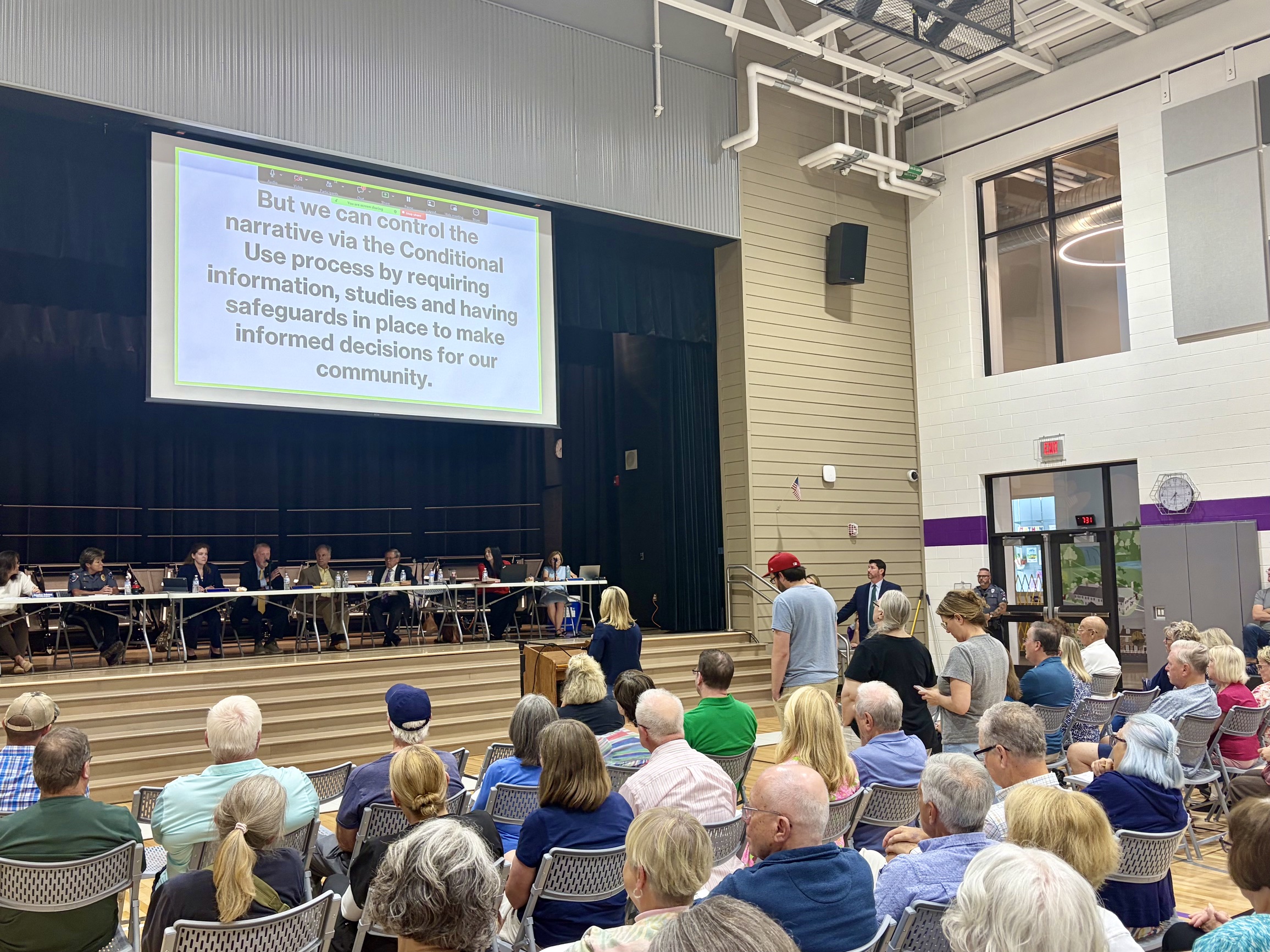
Her concerns have taken her to municipal meetings throughout southeastern Pennsylvania, including communities outside her Senate district, where she has urged local officials to adopt stronger zoning protections.
Muth said the opposition she has encountered has also revealed an unusual degree of political unity. She recalled seeing supporters of President Donald Trump sitting alongside members of the Phoenixville Democratic Socialists at public hearings.
"Everybody was on the same side," she said.
For Muth, that shared concern about health, safety, and quality of life has been one of the few encouraging aspects of the controversy.
Can Data Centers Be Developed Responsibly?
Although Muth has emerged as a leading critic of data center expansion, she distinguishes between conventional data centers and the much larger hyperscale facilities increasingly proposed to support artificial intelligence and other computing demands.
"A hyperscale data center is not a commercial operation," Muth said. "It's an industrial operation."
She argues that these facilities should be regulated accordingly, citing their substantial electricity demands, potential water consumption, emissions, and noise. Her central concern is whether they can operate safely near residential neighborhoods.
Although Muth remains open to ways of reducing those impacts, she said developers have yet to convince her that they can prevent harm to surrounding communities.
"If there's something to mitigate that harm, I am a desperate woman to find it," she said. "I don't know how it exists without harm."
Muth also questions whether the public benefits offered by developers justify the potential risks to nearby residents. Some municipalities have explored community benefit agreements that could provide money for parks, emergency services, or other public amenities in exchange for development.
Muth argues that those agreements should prioritize meaningful protections against environmental and health impacts rather than financial incentives or recreational improvements that do not directly address the potential harm.
"I don't think that that's a community benefit agreement," she said of arrangements that offer amenities without adequately protecting residents. "I think that's a quid pro quo."
She believes public health should remain the central consideration, regardless of the economic benefits a project might offer.
Challenging Conventional Zoning Advice
One of Muth's most persistent arguments concerns the authority municipalities already possess under Pennsylvania zoning law.
As borough councils and township supervisors consider data center ordinances, many have expressed concern that overly restrictive regulations could expose their municipalities to legal challenges from developers.
Muth believes some of those fears have been exaggerated.
She questions the frequently repeated suggestion that every municipality must provide a viable location for hyperscale data centers, arguing that local governments have considerable authority to regulate land use in ways that protect public health and safety.
"Some things just aren't going to fit in some places," she said.
Muth pointed to Pennsylvania municipalities that have no industrial zoning, questioning why some communities appear free to exclude industrial development while others are being told they must accommodate hyperscale data centers. She believes the pressure is particularly intense in areas where developers have identified desirable infrastructure and potential building sites.
"There's nothing in any law or court precedent that says you have to allow a hyperscale data center," she argued.
She also encouraged officials to examine their existing ordinances before assuming they need to create an entirely new zoning category.
"Once you define a use in your zoning, it's technically a legal use," she said, explaining why she questions the rush to establish new categories for hyperscale data centers.
Muth pointed to East Vincent Township as an example of a municipality whose existing regulations already provide a way to evaluate such proposals. Its zoning ordinance allows certain uses not specifically listed to be considered through a conditional use process in designated industrial areas.
She also praised the township's performance standards, which apply across all zoning districts and establish requirements addressing noise, air pollution, vibration, and other potential hazards.
"East Vincent has some damn good performance standards," she said.
Muth believes provisions such as these can provide substantial protections without the need for new data center-specific zoning categories.
She acknowledged that local zoning law is complicated and that she has been learning alongside residents as proposals move through the municipal approval process. Nevertheless, she believes local officials should be more willing to question legal interpretations that appear to limit their authority.
Concerns About Solicitors and Corporate Influence
Muth's criticism also targets the legal and political systems that shape local development decisions, not just individual zoning ordinances.
She expressed skepticism about municipal solicitors who advise local governments on zoning matters, particularly when attorneys or their firms also represent private developers in other communities.
Muth believes those overlapping professional relationships can create potential conflicts of interest that are not sufficiently transparent to the public.
"I think the lack of conflict of interest disclosure is a big, big, big, big problem," she said.
She also questioned whether some municipalities are receiving overly cautious legal advice that encourages accommodating developers rather than testing the limits of their regulatory authority. At the same time, Muth acknowledged that elected municipal officials frequently lack legal expertise and have legitimate reasons to trust the attorneys they hire.
"I have empathy for these local boards," she said.
Her broader concern is that Pennsylvania's system allows political connections, professional relationships, and private development interests to influence local decisions without sufficient public scrutiny.
Muth encouraged municipal officials to request formal written legal opinions from their solicitors, supported by citations to relevant laws and court decisions, rather than relying exclusively on verbal explanations during public meetings.
"When you hire an attorney, they should be able to write you a legal memo with citations in it," she said.
She also urged residents to use Pennsylvania's Right-to-Know Law to obtain records and better understand how decisions are made.
For Muth, improving transparency is essential to restoring public trust in local government.
A Three-Year Moratorium and Emergency Preparedness
At the state level, Muth has introduced legislation that would establish a three-year moratorium on hyperscale data center development and permitting in Pennsylvania.
Senate Bill 1359, introduced in June with bipartisan co-sponsorship, has remained in the Senate Local Government Committee without a vote.
Muth argues that a pause is necessary to give Pennsylvania time to establish more comprehensive protections addressing environmental impacts, electricity costs, land use, and emergency preparedness.
She is particularly concerned about whether local emergency responders are adequately equipped to handle incidents at facilities of such enormous scale. Muth described a conversation her office held with fire and emergency management officials in Loudoun County, Virginia, which has become one of the nation's largest concentrations of data centers.
According to Muth, those officials described challenges involving emergency vehicle access, equipment limitations, and increased demand for emergency services during construction.
She said the officials urged Pennsylvania to require emergency responders to formally approve plans for large-scale facilities, rather than merely allowing them to review the proposals.
"If you can do anything, make that a requirement," Muth recalled being told.
The senator also questioned whether communities should rely on data center developers to address existing shortages in emergency services funding. She argued that Pennsylvania's tax structure places too much responsibility on individual taxpayers while allowing large corporations to avoid paying what she considers their fair share.
"Taxes are why we have roads, bridges, and other services we all use," she said. “But when the big dogs don't pay any money, then we, the little guys, are footing the bill.”
Muth suggested that regionalizing emergency services and reconsidering the traditional volunteer firefighter model could provide more sustainable solutions than relying on contributions from developers.
Frustration With Harrisburg and the Governor
Despite growing public opposition to data centers, Muth is pessimistic about the prospects for comprehensive legislation in Harrisburg. She attributes much of the difficulty to the influence of corporate campaign contributions and the relationships between lawmakers and major industries.
Muth explained that Pennsylvania does not impose contribution limits on donations to state candidates, a system she believes gives well-financed interests excessive political influence. She argues that those relationships transcend party affiliation, making it difficult to assemble sufficient legislative support for restrictions opposed by powerful industries.
Muth has also been sharply critical of Democratic Gov. Josh Shapiro's approach to data center development.
In August, Shapiro signed an executive order establishing new permitting requirements for proposed data centers, including environmental protections, transparency measures, and commitments designed to prevent developers from passing electricity infrastructure costs onto other customers.
The order also removed data center projects from Pennsylvania's expedited permitting program and strengthened the role of local approvals.
Muth acknowledged that public opposition likely influenced the administration's decision and said the changes do not go far enough.
"I think the executive order is the biggest sham," she said.
She criticized the absence of mandatory residential setbacks and expressed concern that the order could give residents a false sense of security about developments still moving through the approval process.
Her frustration with the governor has also intersected with an unusual political movement in her home region. Signs encouraging voters to write in Muth for governor have appeared in communities throughout the Spring-Ford area.
The senator said the effort emerged from dissatisfaction with Shapiro's response to the Pennhurst proposal and other nearby data center developments.
"I'm humbled that anyone would suggest that role for me," she said.
Muth emphasized that she is not directly affiliated with the write-in campaign and remains focused on winning re-election to the Senate. She believes the movement reflects a broader desire for elected officials to be more responsive to public concerns, regardless of political party.
Beyond Data Centers
While data centers dominated the interview, Muth said her broader political priorities remain largely unchanged from when she first entered office.
She wants Pennsylvania to adopt a fairer tax system, strengthen healthcare protections, and reduce the influence of money in politics.
Muth expressed concern about healthcare affordability and whether the state can adequately respond to reductions in federal support for public programs.
"I do lose sleep about healthcare," she said.
She believes Pennsylvania could do more to generate revenue by changing how corporations and certain forms of investment income are taxed.
Muth also emphasized the importance of making government information more accessible. She recalled introducing legislation that would require municipalities to livestream or record public meetings, an idea she said encountered unexpected resistance from some local governments.
She believes greater public access to meetings, documents, and official decision-making would help residents better understand how government works and hold elected officials accountable.
"Government should be making it easy, not harder," she said.
Encouraging Residents to Get Involved
Throughout the interview, Muth repeatedly returned to the importance of public participation.
She encouraged residents to read proposed ordinances, attend municipal meetings, question legal advice, and consider serving on planning commissions or running for local office.
"There's a level of participation for everybody, and everybody needs to do something," she said.
She said public officials should be prepared to explain their decisions, and residents should not assume that a proposed development is inevitable simply because an applicant or attorney says so.
Muth acknowledged that challenging established political and economic interests can be exhausting, particularly when progress in Harrisburg is slow. However, she said the involvement of residents throughout southeastern Pennsylvania has reinforced her commitment to that work.
She also encouraged constituents to contact her district office in Royersford for assistance with legislation, utility issues, housing concerns, and other matters involving state government.
As she seeks another four-year term, Muth said her goals remain centered on reducing corporate influence and creating a government more responsive to the people it represents.
She believes sustained public involvement will ultimately determine whether those changes become possible.
"There's no magic fix coming," she said. "We have to normalize being publicly engaged."