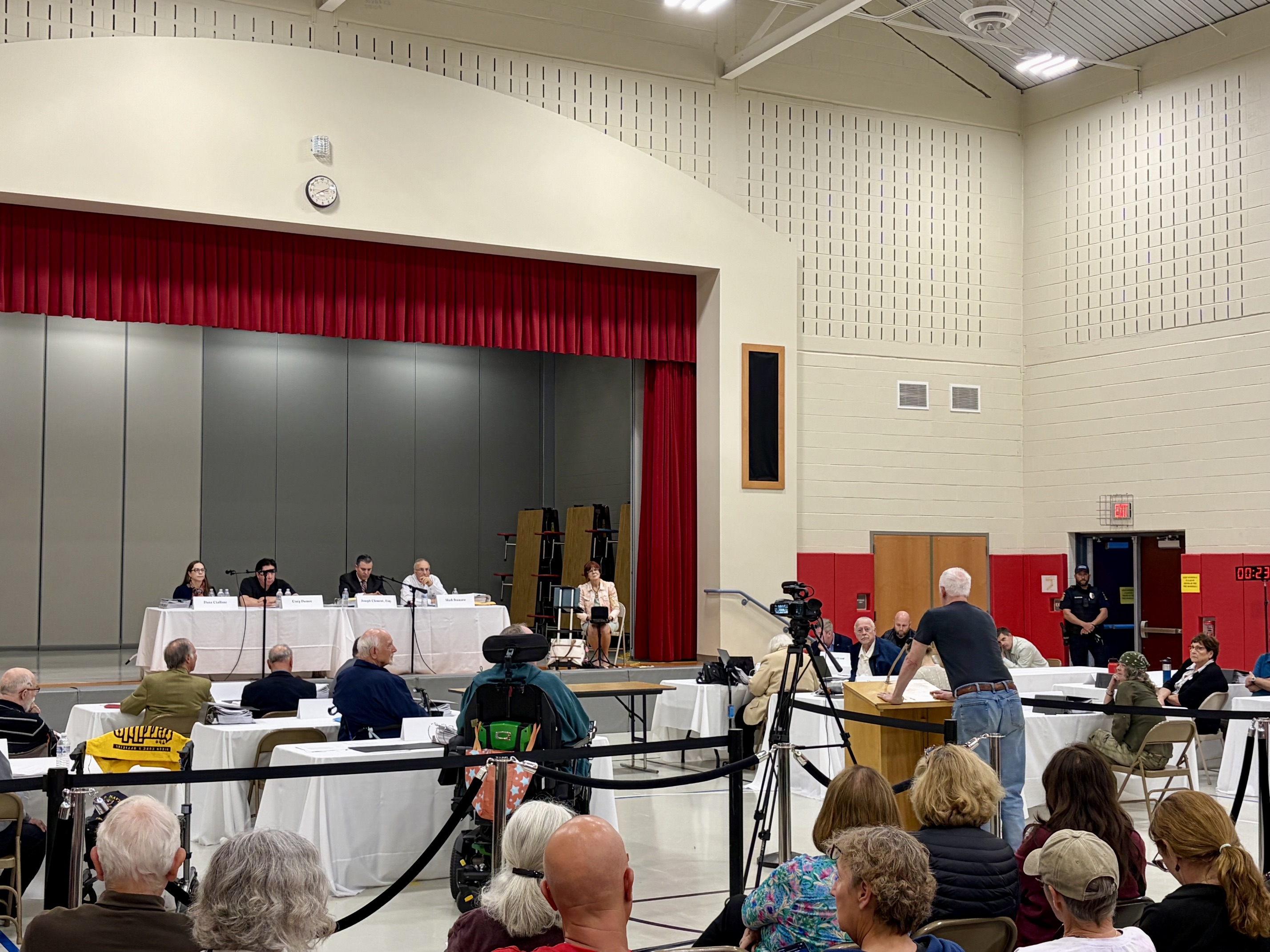
The East Vincent Township Board of Supervisors has voted to deny Penn Hurst Holdings DE, LLC's application for a hyperscale data center on the Pennhurst property, rejecting the current proposal for one of the most contentious land use developments the township has seen in recent memory.
The unanimous decision came at the conclusion of a conditional use hearing held Thursday evening at East Vincent Elementary School, where attorneys, residents, and township officials debated two threshold legal questions: which zoning standards applied to the proposed development, and whether the application could meet those standards.
A Single Use, Not a Mixed-Use Development
At the heart of the dispute was whether the project could qualify as a planned commercial development — a designation requiring more than one principal use on a single lot or tract.
The applicant's attorney, Matthew McHugh, argued that the proposal's combination of a data center, office space, power generation, battery storage, and a customer substation constituted multiple principal uses, creating an ambiguity in the zoning ordinance that should be resolved in the landowner's favor.
Opposing attorneys pushed back. Carl Ewald, representing East Vincent Advocacy, argued that the additional facilities were simply accessories to a single dominant use: a data center.
"The power generation is only and solely planned for supporting this use," Ewald told the board. "To pretend that these are additional uses would be like pretending that I have more than one use on my property because I have a swing set for my kids. That doesn’t make it a home and a park."
Ewald urged the board to deny the application on that basis alone, arguing that the proposal functioned as a single data center use rather than a true mixed-use development. Under the township ordinance, he argued, a standalone data center is only permitted in the General Industrial district — not the Industrial Mixed Use district where the Pennhurst property is located.
Applicant Admits It Cannot Meet Commercial Standards
Even if the board accepted the applicant’s planned commercial development argument, a second dispute remained: which zoning standards would govern the project’s size and design.
McHugh acknowledged that if General Commercial zoning criteria were applied, the application as submitted could not comply.
Ewald said those provisions cap building footprints at 60,000 square feet for a primary structure and 45,000 square feet for additional buildings. The proposed data center buildings, by contrast, far exceeded those limits.
McHugh argued the board should instead apply Industrial Mixed Use or General Industrial standards, which the applicant believed the proposal could satisfy. Ewald countered that the ordinance's plain language leaves no room for that interpretation.
"That's not the choice of the applicant to make," he said. "That was the choice that the board of supervisors had to make when they enacted the ordinance."
Attorney Judith Graham, representing the Pennhurst Memorial and Preservation Alliance, agreed that the application’s size and bulk standards required denial. She also argued that the historic Pennhurst grounds are an irreplaceable cultural resource that any development proposal would need to address.
Nearby residents granted party status — including residents of the Southeastern Veterans’ Center, located just hundreds of feet from the Pennhurst property — voiced support for Ewald and Graham’s arguments and opposition to the data center proposal.
Board Votes to Deny
Following oral arguments, Supervisor Mark Brancato moved to deny the application on the grounds that:
- General Commercial zoning provisions apply to planned commercial developments in the Industrial Mixed Use district;
- the district is not a receiving district for transferable development rights in connection with a planned commercial development;
- the proposed use does not qualify as a planned commercial development; and even if it did, the plan fails to comply with the applicable zoning standards.
The motion passed unanimously, drawing cheers from the audience.
Township Solicitor Joe Clement advised all parties that a formal denial letter would be issued, with a full written decision to follow within 45 days. The decision applies to the current application as submitted and does not prevent the applicant from pursuing a different proposal in the future.
Residents React
The hearing drew an engaged crowd of about 100 people, with law enforcement present and additional security measures in place.
After the motion was made but prior to the formal vote, several residents spoke during public comment in support of the denial.
"Many people for many months have worked hard to get the message across that a data center at Pennhurst is not the right place," said longtime resident and East Vincent Advocacy member Chris McNeil. "I want to just congratulate all the residents of East Vincent Township."
State Sen. Katie Muth, who is also an East Vincent resident, offered pointed remarks from the podium.
"The applicant came in under one theory, relied on one pathway, and when that pathway created problems for them, they tried to shift the standards in the middle of this hearing process," she said. "The applicant cannot use the ordinance one way to get in the door and then argue a different way when the standards become inconvenient."
The Road to Thursday’s Vote
The hearing followed a contentious initial session in April, when the East Vincent Board of Supervisors began determining which residents and organizations would receive party status, allowing them to participate more fully in the proceedings.
Prior to that session, the East Vincent Planning Commission recommended denial of the current version of the plan. In February, commissioners also recommended denial of an earlier version of the proposal.
Meanwhile, in neighboring Limerick Township, a conditional use hearing remains ongoing for a separate large-scale data center proposal near the Limerick Generating Station, with proceedings scheduled to continue June 16.
This article was generated with AI assistance. All content was reviewed, edited, and fact-checked by John McGuire.