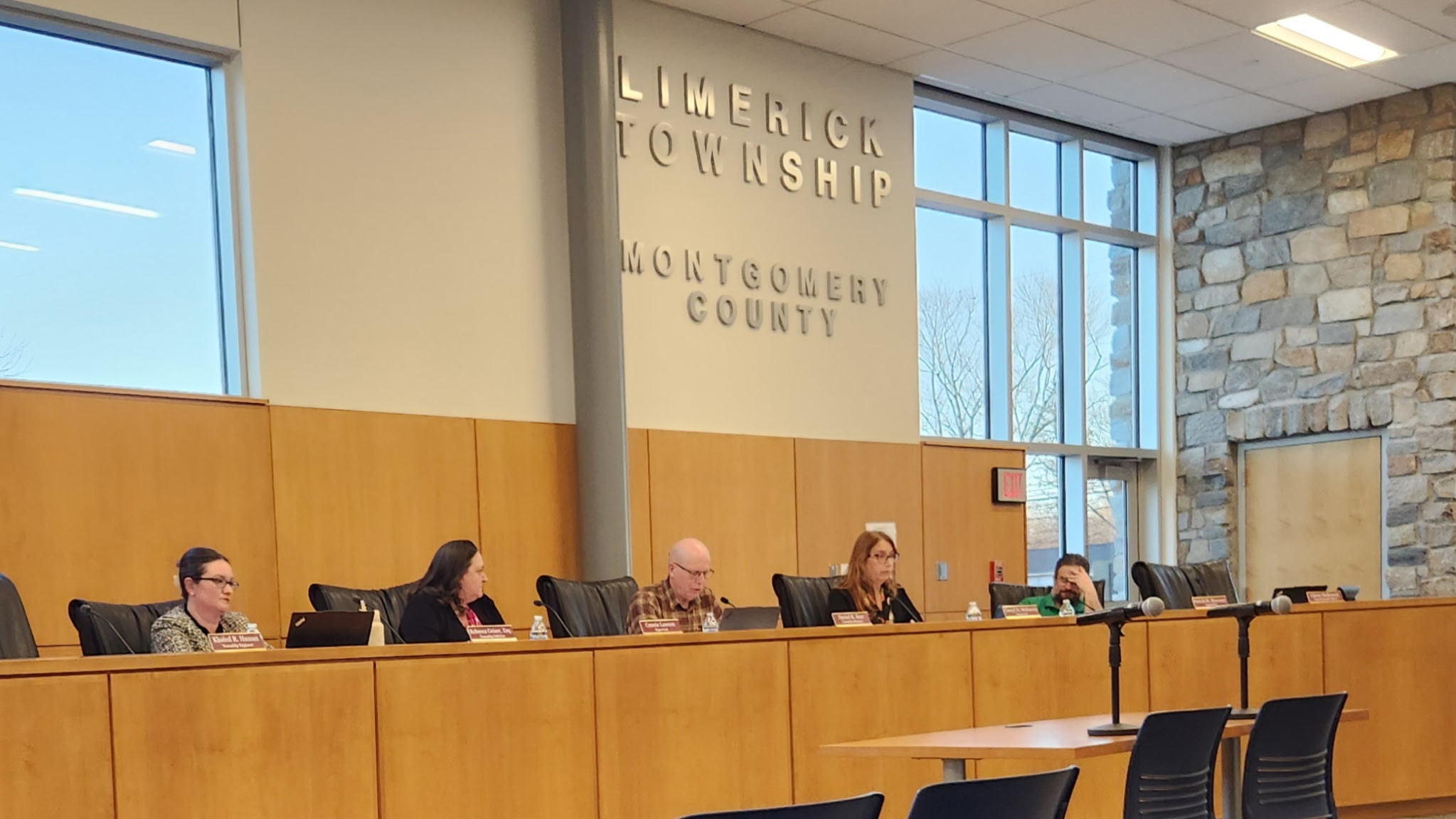
The Limerick Township Board of Supervisors held a special meeting Monday evening to clarify how public questions should be handled during township meetings as the township prepares for upcoming proceedings related to a proposed large-scale data center.
Board Chair Connie Lawson said the goal of the meeting was to establish clear and consistent procedures before upcoming meetings expected to draw significant public interest, including a Planning Commission meeting scheduled for April 9 and a conditional use hearing before the Board of Supervisors on April 14.
Both meetings are expected to address a proposal for a data center development in Limerick Township.
Two members of the five-member board — Kara Shuler and Linda Irwin — were absent from the March 9 meeting due to scheduling conflicts. Statements from both supervisors were read into the record by Township Manager Dan Kerr at the start of the session.
Clarifying Public Comment Rules
The March 9 meeting focused on when and how township officials should answer questions raised during public comment or during discussion of development applications.
In their statements, Schuler and Irwin criticized the decision to hold a special meeting on the issue, arguing that existing practices already allowed officials to answer questions from residents within legal limits or direct township staff to provide follow-up responses when needed. They said the topic could have been discussed during a regularly scheduled meeting and described the special meeting as unnecessary.
Lawson said the board wanted to clarify its procedures before several complex matters move forward.
“I understand that holding a special meeting on this topic may seem unusual,” she said. “But given the number of upcoming land use matters, conditional uses, and the great level of public interest, the goal tonight is simply to establish the process so that the meetings remain fair, orderly, understandable, and involve everyone.”
Limerick Township adopted formal public meeting rules in 2008 that distinguish between general public comment directed to the board and questions directed to witnesses during hearings. The board reviewed those rules and discussed how they should be applied consistently moving forward.
The discussion generally reflected support for answering straightforward administrative or procedural questions during meetings while deferring more complex issues to township staff for follow-up responses.
Township Manager Dan Kerr said staff would need clear direction from the board on when they should respond to questions directly and when answers should be deferred. Kerr noted that previous boards had often relied on township staff to respond to operational questions on their behalf.
Legal Limits During Development Hearings
A significant portion of the discussion focused on legal constraints that apply during zoning and conditional use hearings.
Rebecca Geiser, the township solicitor, explained that when the Board of Supervisors conducts a conditional use hearing, members effectively act as judges in a quasi-judicial proceeding. Because of that role, supervisors must avoid answering questions or expressing opinions about a project outside the formal hearing process.
Instead, testimony and questioning typically occur during the hearing itself, where applicants present witnesses and evidence. At this hearing, parties with legal standing may ask questions.
Geiser also said that public comment related to such hearings occurs only at the conclusion of the hearing process, after all testimony has been presented. Because multiple parties are expected to participate in the upcoming proceedings related to the data center project, the solicitor noted the conditional use hearings could span several meetings.
“I wish I could say it would be one hearing that this will take, but let's be realistic,” Geiser said. “We know of at least two parties – the township and the school district – and that alone will have multiple witnesses,” adding that the proceedings will likely take “multiple evenings.”
“I will make it very clear from the very beginning that public comment is not appropriate and legally not permitted until the very end of the hearings,” she noted, emphasizing the plural “hearings.”
She also mentioned that emails may potentially not be considered because questions can arise about authentication. She highly encouraged anyone who wants their comment to be heard regarding a conditional use application to attend the hearings related to that application.
Once the hearing process formally begins, township officials said the board will not be able to answer questions about the project outside of that process.