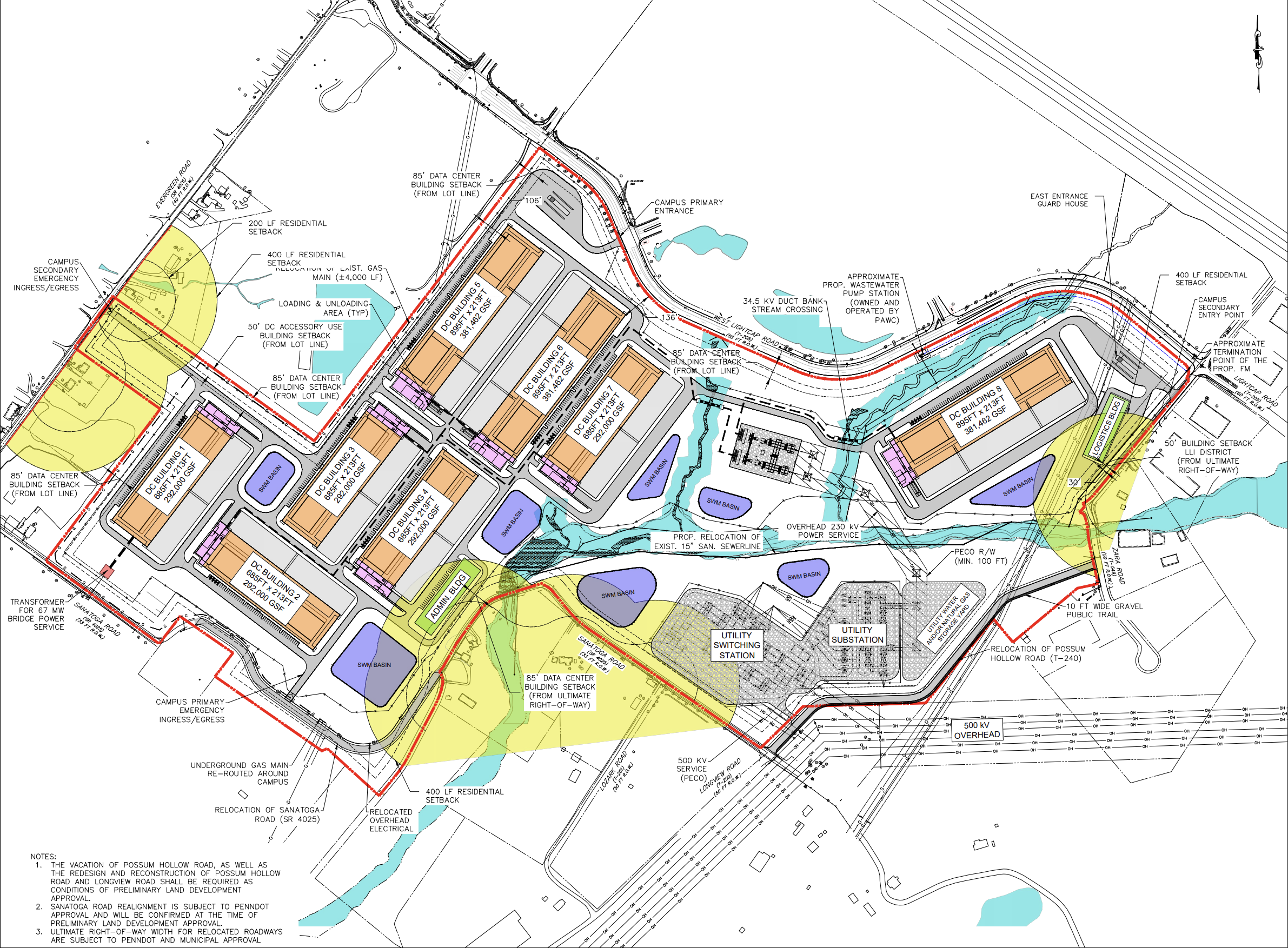
A traffic engineer hired by the developer of a proposed data center campus in Limerick Township testified Thursday that the project would generate relatively little traffic and would not create a significant safety hazard, while attorneys and residents questioned the data and assumptions behind his conclusions.
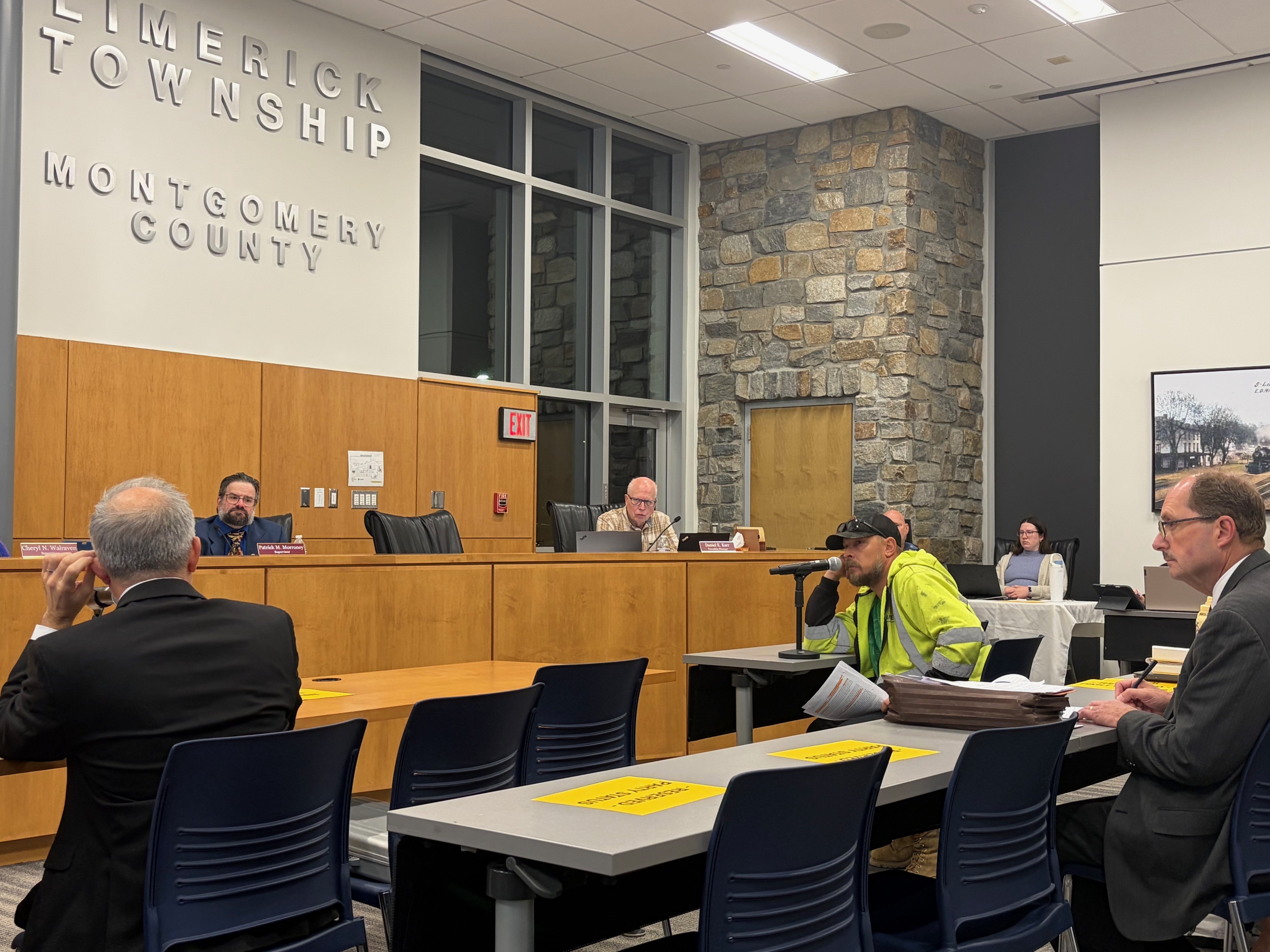
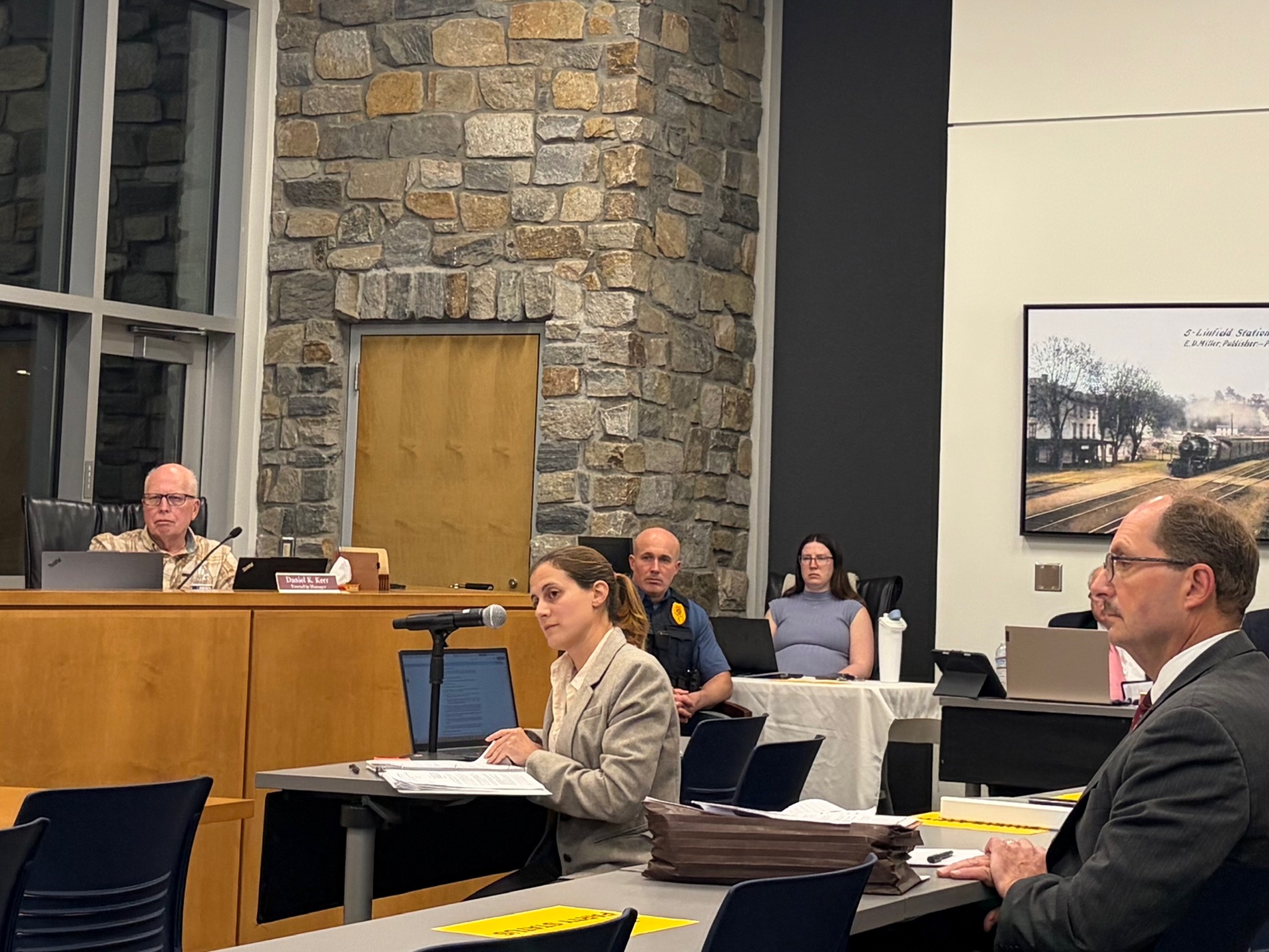
Frank Tavani, the applicant's traffic engineer, appeared at the October 1 conditional use hearing for MCD7, LLC's proposed eight-building campus near the Limerick Generating Station and Philadelphia Premium Outlets. The hearing was the latest in a proceeding that began in April, following the previous hearing on September 8. The board of supervisors accepted Tavani as an expert in traffic engineering before his substantive testimony.
Tavani said the 2.76 million-square-foot development would produce 193 vehicle trips during the weekday morning peak hour and 138 during the afternoon peak, figures he described as low for a project of that size.
He said he relied on the Institute of Transportation Engineers (ITE) Trip Generation Manual, which includes a land-use code for data centers. He also used traffic counts he believed were collected in January 2023 and included in a January 2024 traffic impact study prepared by Bogia Engineering Inc. for a previously proposed warehouse and retail development on the same site.
Tavani said he used a higher background traffic growth rate than PennDOT’s recommended rate, which he said resulted in more cautious projections by assuming greater future traffic growth. He also testified that the project's primary access was moved to Lightcap Road, opposite an existing signalized intersection serving Philadelphia Premium Outlets, following a recommendation from the township's traffic engineer.
Findings on Traffic and Levels of Service
Tavani concluded that the proposed data center would not result in or substantially add to a significant traffic safety hazard or significant traffic congestion.
In explaining that conclusion, he testified that intersections throughout the study area generally perform well under existing conditions, with overall levels of service of C or better and individual turning movements rated D or better.
He described “level of service” as similar to a report-card scale ranging from A to F, with A representing the best traffic conditions, E indicating conditions near capacity and F indicating conditions that are likely over capacity. The ratings are based in part on the average amount of delay experienced by vehicles.
Tavani said the most significant projected constraint involves the westbound left turn from the Route 422 eastbound off-ramp at Evergreen Road. That movement is expected to reach level of service F during the weekday morning peak hour in future conditions even without the data center.
Despite that projected constraint, Tavani said the overall intersection would remain at level of service C in future conditions both with and without traffic from the proposed development.
Tavani said it was his understanding that PennDOT is already examining potential improvements to the ramp, including possibly restriping the shoulder to create a three-lane approach.
With the data center, Tavani said the overall performance of that intersection during the morning peak hour would worsen by about eight seconds compared with future conditions without the project. He said that remains below the 10-second threshold PennDOT uses when considering whether capacity improvements may be warranted.
Questions From the Township and School District
Mike Furey, the township's attorney, questioned Tavani about his estimate of approximately 400 parking spaces and as many as 25 shift employees per building.
Furey noted that the applicant had previously advised the water company that the site would have 300 employees, while the applicant's land planner had assumed 451 employees.
Tavani said the project's estimated number of employees is not directly used in the ITE trip-generation calculation, which projects traffic based on building square footage. He said employee trips, along with deliveries, visitors and other traffic, are already reflected in the data underlying the model. He acknowledged that the actual number of employees could affect how much parking the development needs.
Furey also said the township zoning ordinance requires a parking study approved by the township's traffic consultant and argued that deferring additional parking analysis until land development would not satisfy the zoning code.
Tavani said he had not independently reviewed that parking requirement and would take Furey at his word.
An attorney representing the Spring-Ford Area School District questioned whether the traffic counts had been collected while school was in session and whether relying on January 2023 data was reasonable given subsequent growth in the township.
Tavani said he did not know whether school was in session when the counts were taken, but defended using the data because the analysis projected conditions forward to 2031 using background growth and traffic from other developments. He said the relevant comparison in a traffic impact study is between future conditions with and without the proposed project.
Challenges From Other Parties
An attorney representing MCD2 and MCD9 questioned whether Tavani’s analysis fully accounted for traffic from a proposal to develop the adjoining 168 Evergreen Road property with 256 apartments, a car wash, a Sheetz, and two quick-service restaurants.
Tavani said he adopted future traffic conditions from the prior Bogia study and made additional changes requested by the township's traffic engineer. However, he could not say during the hearing exactly what uses from the nearby property had been included in the earlier study. The attorney representing MCD2 and MCD9 requested the opportunity to further cross-examine Tavani after reviewing the full Bogia report.
Lauren Otero, an attorney representing a group of residents who live near the site, questioned whether Tavani's report relied on the correct version of the township's traffic ordinance, which was amended in June 2025. After reviewing a copy provided during the hearing, Tavani acknowledged that the ordinance language shown to him differed from the version reproduced in his report.
Otero also questioned Tavani about truck traffic associated with the site's proposed diesel emergency generators. She noted that project manager A.J. Magnotta had previously testified that the campus would include 306 generators.
Tavani said normal truck traffic at the site would be minimal and estimated that generator testing could require at most about one fuel delivery per day. He acknowledged that he had not performed site-specific fuel-consumption calculations for the Limerick project and said the estimate was based partly on calculations he had previously performed for a larger proposed data center project near Scranton.
He also said he did not recall calculating fuel consumption during an emergency in which the generators would need to operate for an extended period.
Individual party-status holders questioned the lack of a weekend traffic analysis, congestion around the Philadelphia Premium Outlets during the holiday shopping season, potential lunchtime trips by employees, and emergency evacuation conditions related to the nearby nuclear plant.
Tavani acknowledged that lunchtime traffic was not specifically studied, but said morning and afternoon commuter peaks were selected because they typically represent the busiest traffic conditions in the study area.
He also confirmed that no formal nuclear evacuation traffic analysis had been conducted. Tavani said he had not consulted the Limerick Generating Station operator, county or state emergency management agencies, State Police, local emergency responders, or the Nuclear Regulatory Commission as part of his study.
The board of supervisors asked no questions of Tavani.
The hearing was continued to October 27 at 6:30 p.m.