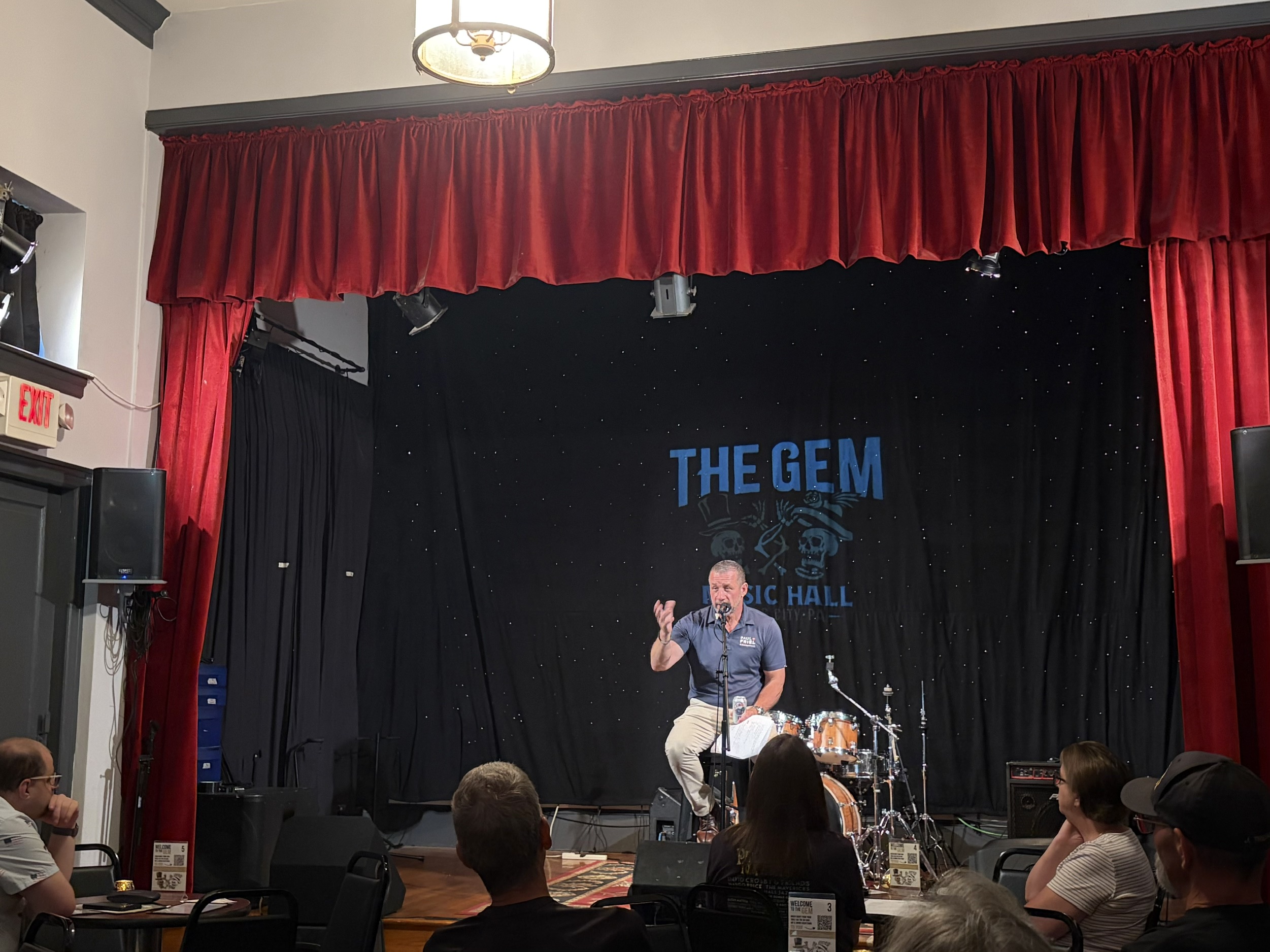
State Rep. Paul Friel told residents at a Spring City town hall that eight bills the Pennsylvania House has passed to mitigate or regulate the effects of data centers have not advanced in the state Senate, leaving municipalities largely on their own as developers pursue projects across Pennsylvania.
Friel, a Democrat, represents Pennsylvania's 26th House District, which includes Spring City, East Vincent Township, East Pikeland Township, and Phoenixville, along with other northern Chester County communities. He held the meeting at The Gem Music Hall on Tuesday evening, where more than 25 people attended.
While the roughly 90-minute discussion ranged from affordability and healthcare to election security and agriculture, data centers became one of the evening's central topics.
Friel said there are about 50 data center proposals statewide. He pointed to a proposal at the Pennhurst property in East Vincent, another in Limerick, and noted a proposal in North Coventry Township was withdrawn.
"There are eight bills that passed the House that are to mitigate or stop or control the effects of data centers," Friel said, adding that "zero of them" have been voted on in the Senate.
He said the divided legislature has contributed to the impasse, adding that Senate leadership has indicated it does not plan to bring data center bills up for votes. The House holds a slight Democratic majority, while Republicans control the Senate.
Local Control Over Zoning
Friel said much of the decision-making regarding data centers rests with local governments rather than the state. He said zoning decisions in Pennsylvania are made locally, limiting what Harrisburg can do directly.
"All those decisions are local decisions," Friel said. "Those townships have the power more so than the state does to approve or disapprove that."
He said the state's role is to change laws so municipalities have stronger protections. Friel said he sponsored a six-month moratorium bill that could be paired with a curative amendment, also six months, allowing a municipality to pause data center development for up to a year while it reviews zoning and land development rules. He said the bill passed the House 200-1 and unanimously cleared its first Senate committee before stalling without a floor vote.
Other Data Center Measures
Friel described several other proposals. He cited House Bill 1834, sponsored by Rep. Rob Matzie, which he said addresses electricity pricing and consumer protection while including provisions intended to mitigate data center impacts. He said other House bills address water usage, electricity usage, land usage, and model zoning ordinances that municipalities could adopt.
Friel also referenced two Senate measures that he said have not advanced: a three-year moratorium bill from Sen. Katie Muth and an 18-month moratorium bill from Sen. Jarrett Coleman. He said an attempt to amend Muth's bill in committee was defeated 9-2 after lawmakers raised concerns about the constitutionality and drafting of a blanket three-year moratorium. He said Coleman's bill cleared committee but "didn't go anywhere after that."
"I support all three of those particular bills and I voted for all eight other bills that stop, mitigate, or put protections against data centers," Friel said.
He emphasized the measures carry no force unless they pass both chambers and are signed into law.
"Right now they're just pieces of paper, my bill included."
Incentives and Court Fights
After an attendee asked about state tax incentives for data center developers, Friel said two House bills address the issue. He said one measure, sponsored by Rep. Greg Vitali, would eliminate the incentives entirely and passed the House by a wide margin, signaling bipartisan support. Another measure, sponsored by Rep. Joe Webster, would also revise the incentives. Friel said he voted for both.
Friel said he was optimistic lawmakers could revisit the incentives when they return to session, arguing tax breaks are unlikely to determine whether companies worth hundreds of billions of dollars choose to build data centers in Pennsylvania.
"It's not going to make you come here or make you stop coming here," he said of the companies behind the projects.
Friel also said individual municipalities often face an uphill battle defending zoning decisions against well-funded corporations on their own. He argued that state-developed model ordinances adopted by multiple municipalities could strengthen local governments' position, making legal disputes less about a single township facing a large corporation and more about enforcing standards shared across many communities.
The General Assembly returns to session this fall, when Friel said lawmakers will have another opportunity to consider data center legislation.
"There's a lot of pressure to do something," he said.