Homespring city
SPRING CITY • DEVELOPMENT

Spring City Zoning Board Grants Relief for Twin-Home Plan on Poplar Street Lot

AI
Powered by diffuse.ai

Published Mar 26, 2026 at 10:37 PM EDT (Updated Mar 26, 2026 at 10:43 PM EDT)

Spring City Zoning Board Grants Relief for Twin-Home Plan on Poplar Street Lot
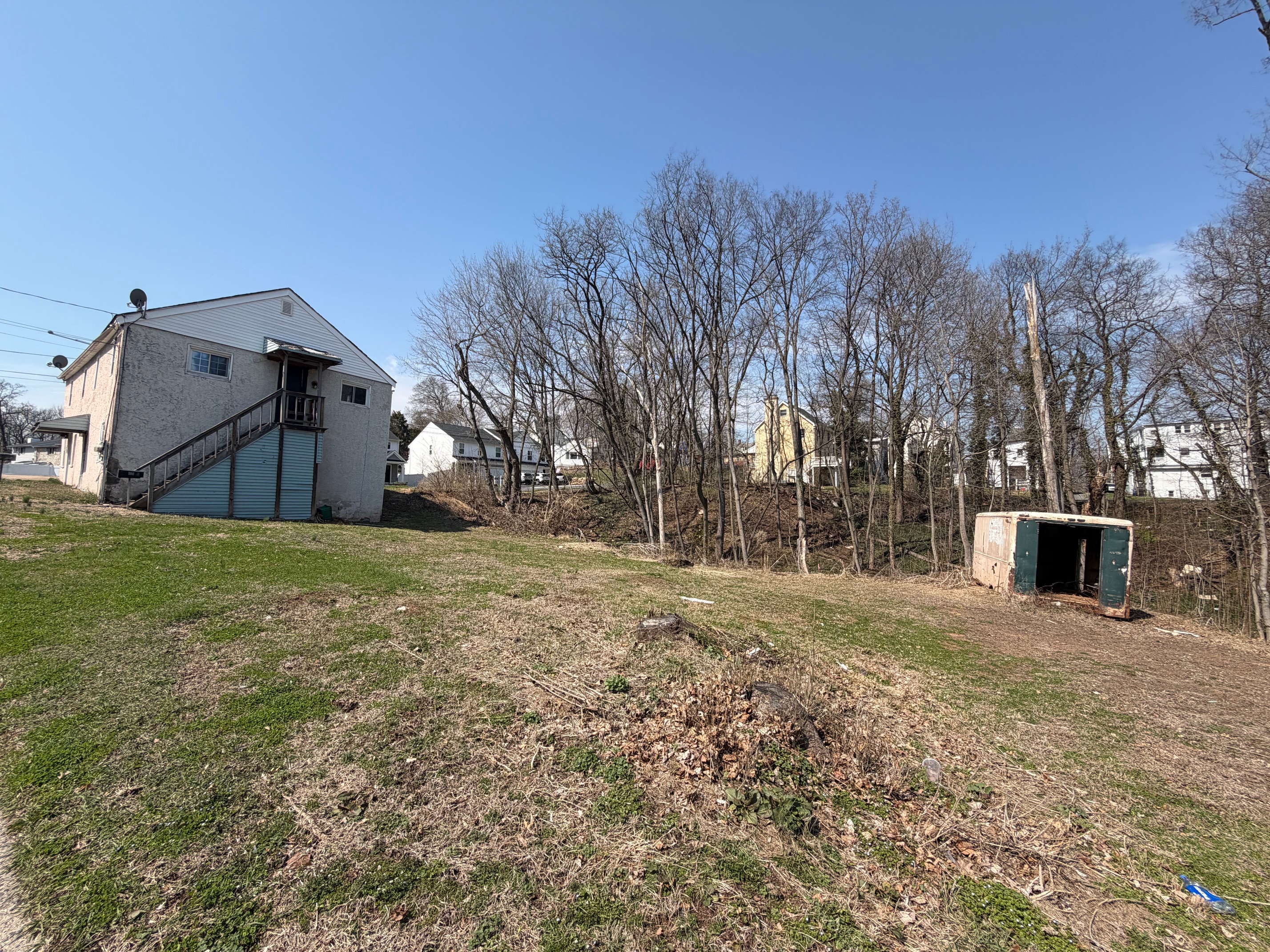
A developer is looking to convert a vacant lot at 177 Poplar Street into a pair of attached homes.

A developer received the zoning relief needed to move forward with a plan to build a pair of attached homes on a vacant Poplar Street lot, after the Spring City Zoning Hearing Board approved variances tied to steep slopes and on-site parking on Thursday evening.

The application was filed by RB Ashley Customs, LLC, which presented a plan for a semi-detached, two-family dwelling in the borough’s R-3 high-density residential district. The property at issue — identified during the hearing as Parcel B — is currently vacant and located along Poplar Street near S. Church Street, on a primarily residential block.

An adjoining corner property at Poplar and S. Church, which includes a vacant multi-unit apartment building, was not part of the hearing.

Under the approved concept, the developer intends to subdivide Parcel B into two lots, labeled B1 and B2, with proposed lot sizes of 5,481 square feet and 5,443 square feet. Each side of the twin would have a single-car garage and a driveway space, providing two off-street parking spaces per unit.

While the proposed use is permitted in the zoning district, the project required zoning relief because of steep-slope disturbance on the site and because the driveway space does not meet the full depth standard the borough applies to off-street parking.

Steep Slopes and Stormwater Design

Heath Machamer, an engineer testifying for the applicant, described the site’s terrain as containing two regulated slope categories — 15 percent to 25 percent and 25 percent or greater — near the rear portions of the lots, where the property descends toward a Schuylkill River tributary. Machamer said a team completed stream-related field work and determined there were no wetlands associated with the stream corridor.

For the 15 percent to 25 percent slope category, the applicant said the plan stays within the borough’s disturbance limits. The engineer testified that proposed disturbance would be about 7.4 percent of the 15 percent to 25 percent slope area on lot B1 and exactly 30 percent on lot B2, matching the maximum allowed.
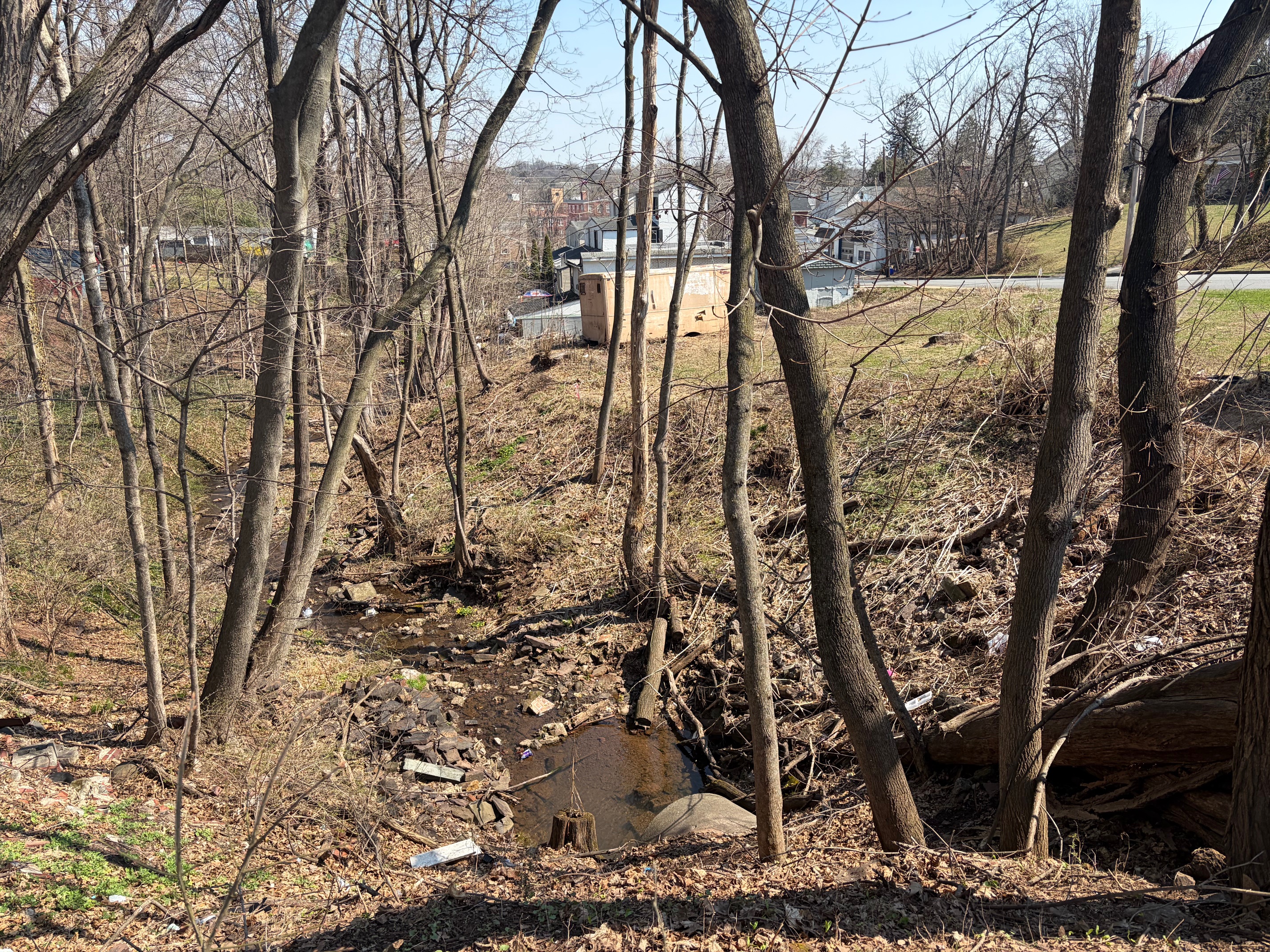
A Schuylkill River tributary runs behind the property.

The variances centered on the more restrictives slopes designated 25 percent or greater. The engineer testified that the plan would disturb about 21.6 percent of the greater-than-25-percent slope area on lot B1, above the 15 percent allowed, and about 43.8 percent on lot B2.

The engineer also told the board that some of the steep slopes near lot B2 appear to have been altered by historic fill and regrading, but the ordinance does not distinguish between man-made and natural slopes. As a result, the applicant reported the slope conditions as they exist today.

Board members’ questions focused on how construction and drainage would work on the sloped portions of the site. The applicant described a stormwater approach that relies primarily on an infiltration bed behind the units, collecting roof runoff and directing it into the system rather than allowing downspouts to discharge onto neighboring properties. Testimony also described a controlled outlet routed to a level spreader near the creek, where runoff would be dispersed.

Parking Variance and Board Conditions

On-site parking also drew scrutiny. Plans show the buildings set close to Poplar Street, leaving a driveway length that the board described as slightly short of the standard depth. During deliberations, the board and applicant discussed the request as a one-foot variance — allowing a parking space depth of about 17 feet to the edge of the sidewalk instead of 18 feet.

The board approved the requested relief and attached a condition aimed at limiting grade change in the rear yard area. As described during the hearing, the condition requires the slope between the rear of the dwelling area and a retaining wall to be no more than 5 percent, an adjustment board members said would reduce the steepness residents would experience behind the homes.

A written decision is expected to follow, with the solicitor indicating the conditions would be finalized in the written approval and shared with the applicant’s team to confirm the technical wording matches what was discussed at the hearing.