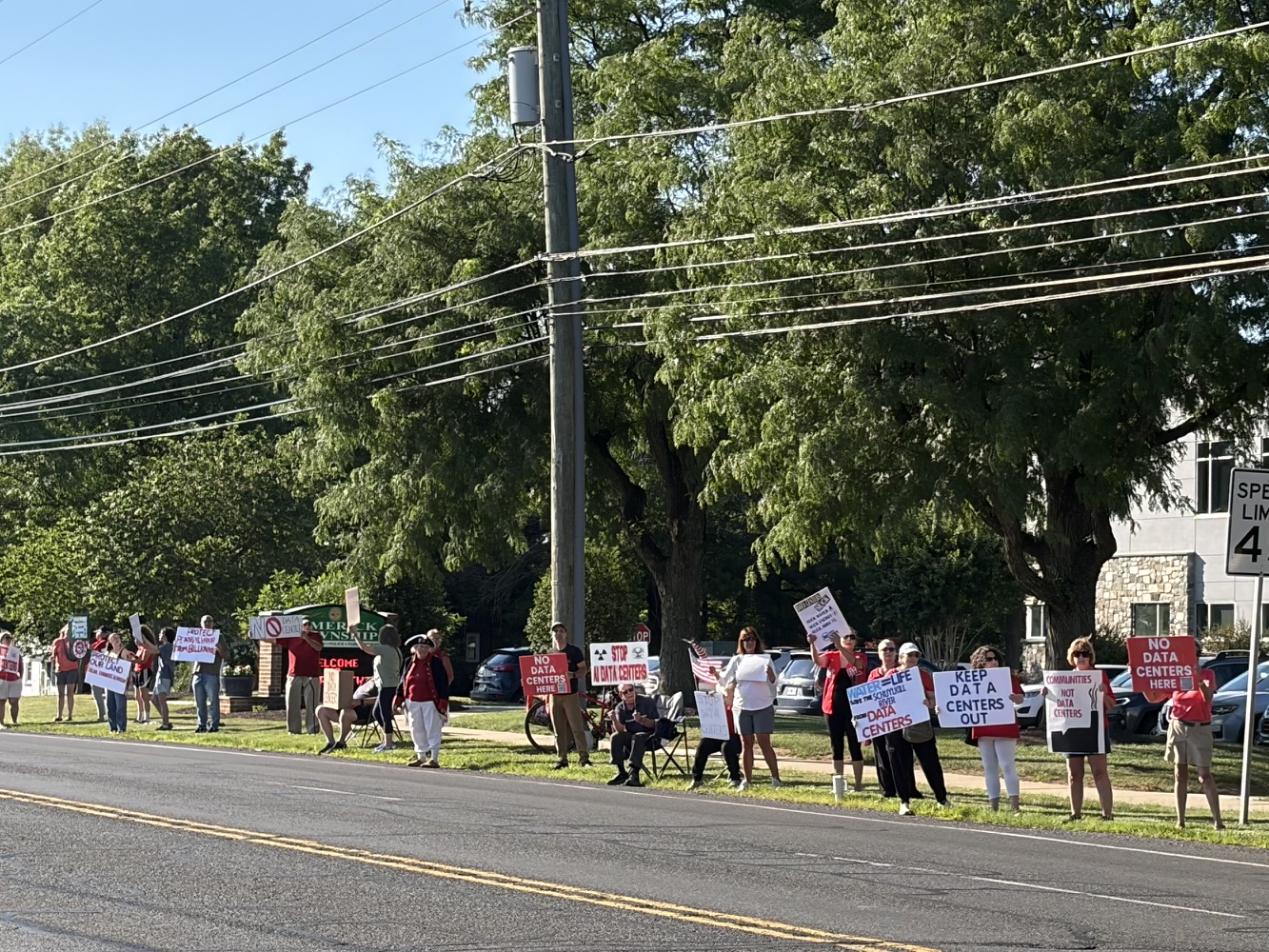
A proposed large-scale data center project returned to the hearing room Tuesday, where township officials and residents continued pressing the applicant’s team on unanswered questions while objecting to new exhibits introduced just before the hearing began.
The session marked the third installment of a multi-month conditional use proceeding before the Limerick Township Board of Supervisors. Supervisor Linda Irwin and township solicitor Rebecca Geiser were absent due to previously scheduled vacations. Board Chair Connie Lawson noted both would review transcripts and recordings before the process moves forward.
The application, submitted by MCD7, LLC, seeks approval for a campus including eight data center buildings on approximately 191 acres across seven parcels. The site is located near the Limerick Generating Station and Philadelphia Premium Outlets.
In recent months, Limerick officials have been drafting and reviewing revised data center regulations. However, those changes would not apply to either the MCD7 proposal or a separate proposed data center at the former Publicker Distillery site in Linfield, both of which will be reviewed under the ordinances adopted in 2024.
The June 16 hearing was held at the Limerick Township Building and livestreamed on YouTube.
New Exhibits Spark Immediate Dispute
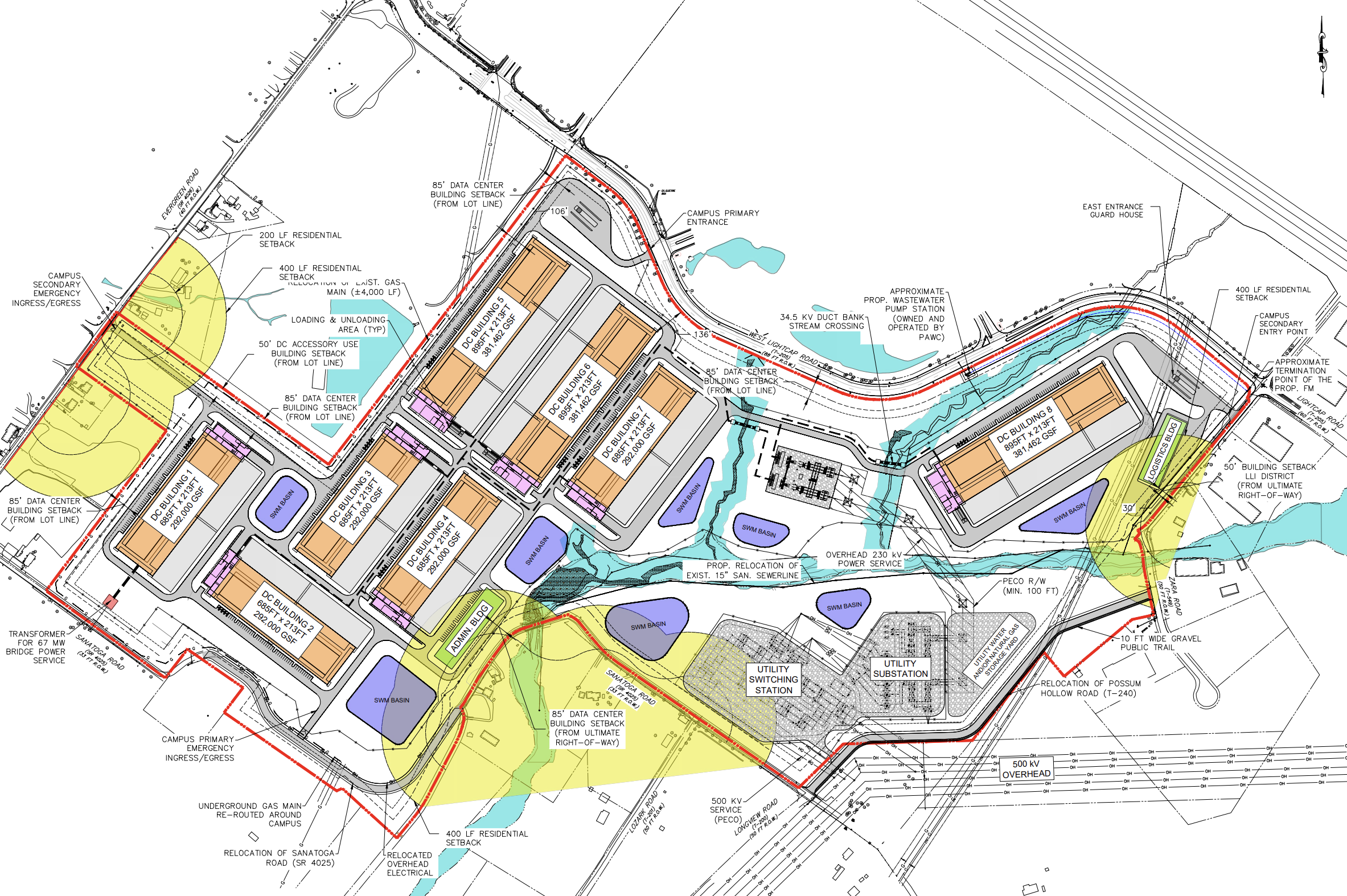
Before cross-examination resumed, the developer's attorney Ed Campbell circulated additional exhibits, including a modified site layout labeled Exhibit 7.
Township attorney Wendy McKenna immediately objected to the alternate layout, arguing it was not part of the original application and had not been available for public review.
"If this is a brand new plan, then that may not have been properly complied with," McKenna said, raising concerns about legal notice requirements.
Campbell disagreed, arguing that conditional use applications are "fluid" and that the exhibit was a demonstrative tool intended to address questions raised during the May 11 hearing rather than an amendment to the application.
Acting solicitor Sean Kilkenny allowed the hearing to proceed but made clear that parties would have an opportunity to review the new exhibits and question witnesses about them at a future hearing. The hearing continued on testimony already in the record, while parties reserved the right to recall witnesses after reviewing the additional materials.
Party-Status Holders Question Magnotta
Residents Alexandria Sasek and Joshua Mangle, both of whom have party status in the proceeding, continued questioning project manager Albert Magnotta of LaBella Associates. Much of the May 11 hearing had been devoted to Magnotta's testimony, but time constraints prevented several party-status holders from completing their cross-examination.
Sasek asked Magnotta to clarify street names shown on the site plan — which she said was a point of confusion from the previous hearing — and questioned whether he had studied data centers located adjacent to nuclear power plants. Magnotta said he had not.
Mangle focused much of his questioning on water use and cooling operations. Magnotta testified that his understanding was that water would be supplied by Pennsylvania American Water and that some discharge would enter the wastewater collection system. However, he repeatedly deferred detailed questions about the cooling system and water consumption to a future data center operations witness.
“That will be discussed in detail by the data center consultant,” Magnotta said, echoing a response he gave frequently during the previous hearing.
Supervisors Question the Witness
The board of supervisors then questioned Magnotta about various aspects of the proposal.
Supervisor Cheryl Walraven asked about the project team and whether members had previously worked on data center projects. Magnotta testified that most members of his team had worked on data center projects before, but none of those projects had yet been built and placed into operation.
Walraven also asked whether the stormwater management plan would need to change once the final generator and chiller designs are selected. Magnotta said the stormwater system was designed around site layout and building footprints and would not require revisions based on the specific equipment ultimately installed.
Supervisor Patrick Morroney raised concerns about fuel storage and spill containment associated with the project's proposed diesel generators.
“This is a pollution issue," Morroney said. "I want to make sure it's not coming out to the environment."
Magnotta testified that fuel storage would be governed through a separate spill prevention control plan, permitting, and other regulatory safeguards.
Morroney also questioned why the Limerick Township Planning Commission's recommendation to consider natural-gas generators rather than diesel generators had not yet been addressed. Magnotta deferred the question to a data center consultant.
Lawson asked a series of questions that led to an exchange about site design, generator counts, geotechnical studies, substations, truck access, and private wells. When asked whether a hydrogeological study had been conducted to evaluate potential impacts on nearby private wells, Magnotta said he was not aware of one.
During redirect examination — a chance for Campbell to question his own witness after cross-examination — the developer’s attorney focused heavily on the proposed Possum Hollow Road vacation and the project's internal road crossings. Magnotta testified that the crossings are internal connections rather than "driveways" as defined by township ordinances, and said the project could still be built if Possum Hollow Road remains in place. According to Magnotta, that scenario would require modifications to Building 8, additional fencing, and changes to access arrangements for the southern substation.
Developer Introduces Second Witness
Following redirect examination, Campbell called Anthony Maras, a Pennsylvania-licensed attorney and project principal representing the applicant, MCD7.
Maras described the project's evolution from the original 117-acre Boyd Tract to the current 7-parcel application, including two parcels acquired from the Tornetta family.
According to Maras, the company first evaluated whether a data center could be developed on the original tract after studying existing geological and stormwater information and conducting power-availability reviews with PECO. He testified that, at the time, the township's opinion was that a data center would be permitted by right in the zoning district.
Maras also addressed the proposed vacation of Possum Hollow Road. He testified that the commitment to vacate the road and relocate Longview Road predated MCD7's involvement with the property and originated with a prior development proposal. According to Maras, MCD7 agreed to honor that commitment after acquiring the properties involved.
Asked whether the project could still proceed if Possum Hollow Road remains in place and Longview Road is not relocated, Maras testified that it could. He said the project could be built whether Possum Hollow Road is vacated or remains in place, and suggested that retaining the road may, in some respects, simplify the design.
Cross-examination of Maras was deferred to allow parties time to review the newly circulated exhibits.
Hearing Continued to July 21
Following a brief executive session, the board voted to continue the hearing to July 21 at 6:30 p.m. at the Limerick Township Building, 646 West Ridge Pike.
On the record, Campbell waived the Pennsylvania Municipalities Planning Code's timing requirements through the planned August 18 hearing date, allowing the township to continue the hearing process without triggering a potential deadline dispute.
The applicant also agreed to provide exhibits, expert reports, and expert witness resumes at least 10 days before upcoming hearing dates. Township officials indicated the materials would be distributed to party-status holders in advance of future sessions.
This article was generated with AI assistance. All content was reviewed, edited, and fact-checked by John McGuire.