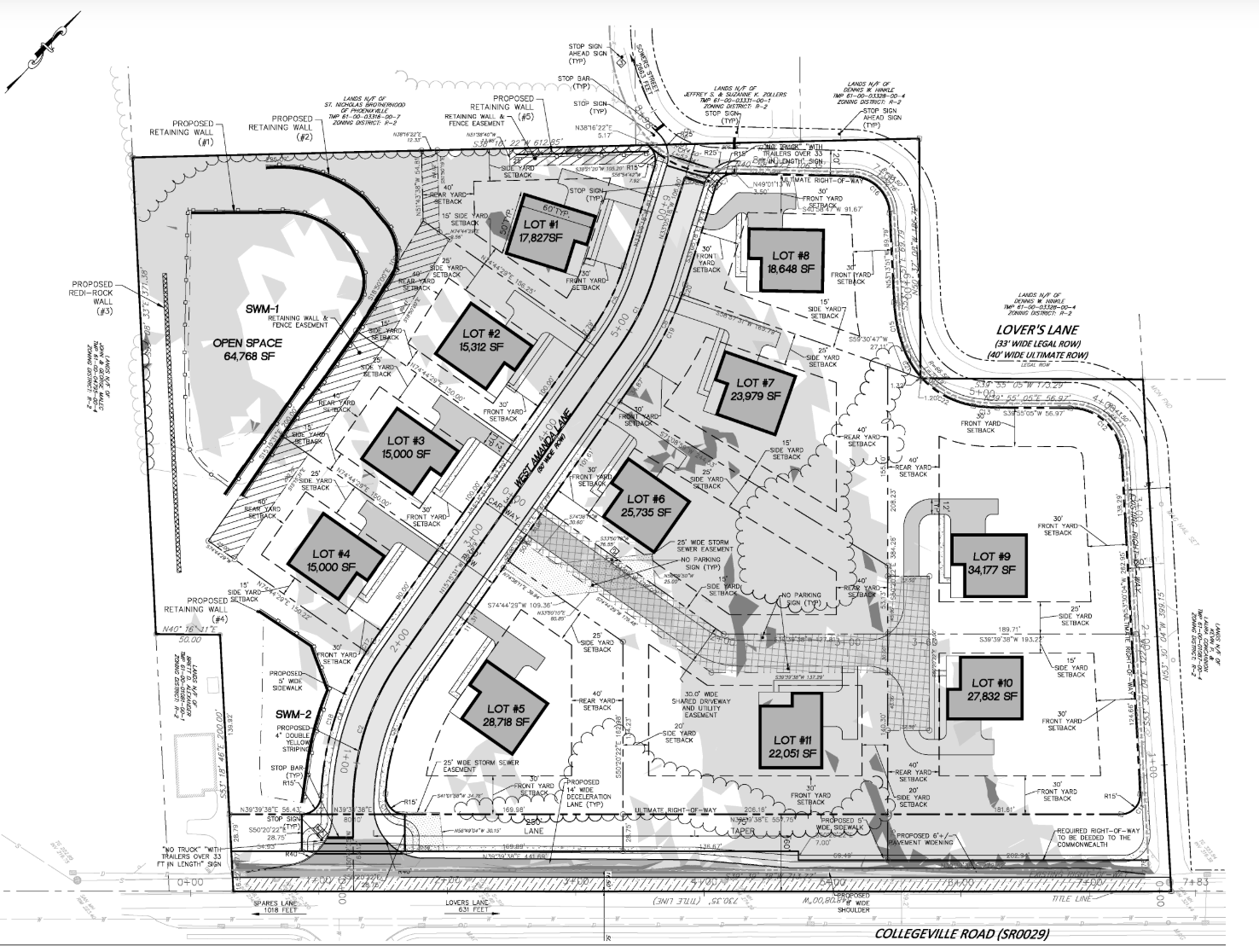
Upper Providence Township supervisors voted 3-2 this week to approve an 11-home development on 9.42 acres located at the intersection of Collegeville Road and Lovers Lane.
The decision was made despite lingering concerns about required blasting near residences and a cemetery, and whether the project's stormwater system could withstand increasingly intense storms.
Board Chair Kelly Stevens and Supervisor Tom Yeager voted against the project, though the board's discussion acknowledged that there appeared to be no legal basis to deny the application.
Township solicitor Zachary Sivertsen explained that the development team’s due diligence had placed the board in a constrained legal position because the application met the township’s standards, included no waiver requests, and had already received every required outside agency approval.
"This may be the first time we've ever seen a waiver-free plan," Sivertsen said. "There just isn't any reason for the township to really be denying this application."
What's Being Built
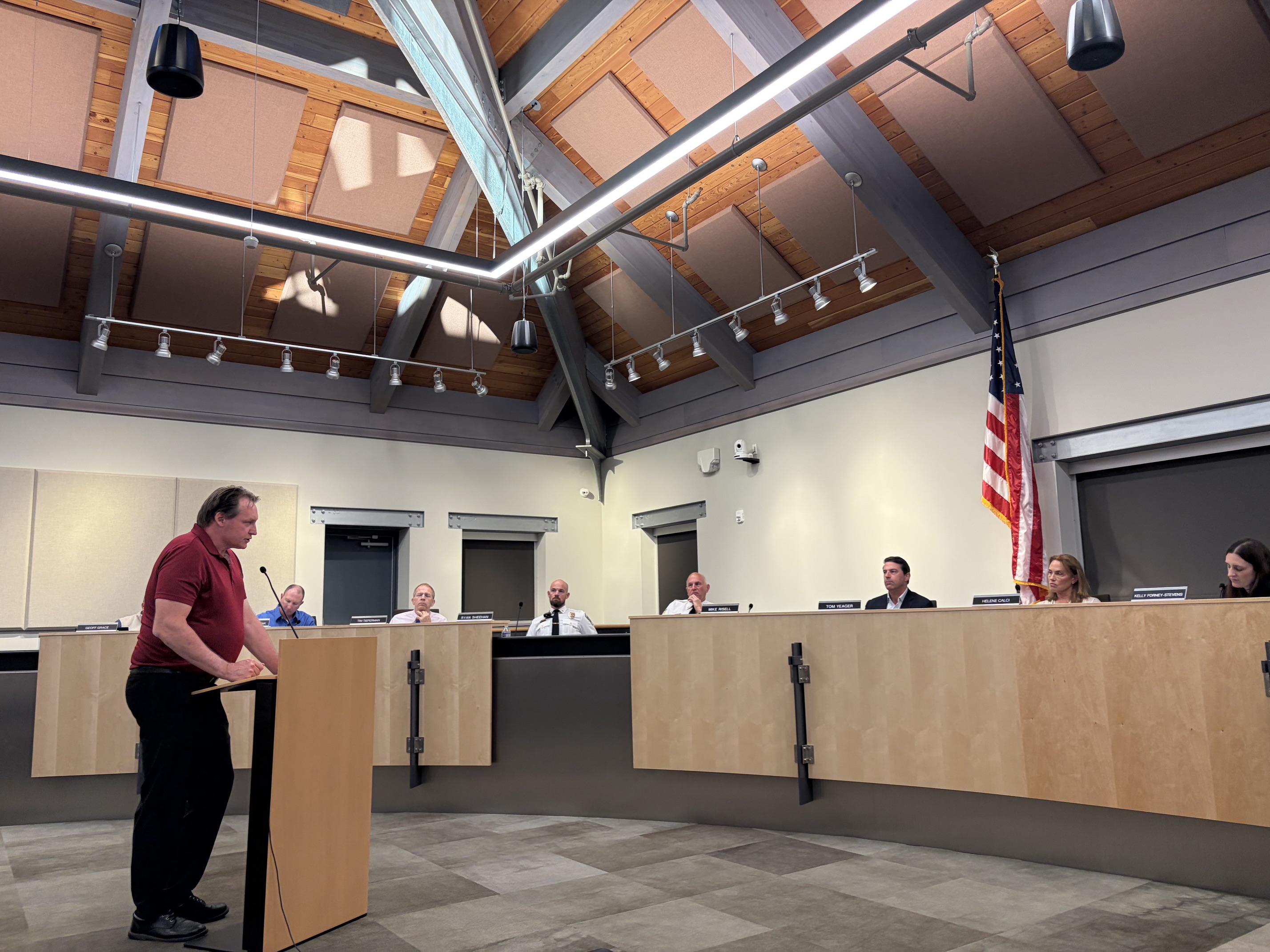
Representatives of developer General Hancock Partnership Enterprises, L.P., presented the proposal during the Upper Providence Township Board of Supervisors meeting on Monday, June 15. The plan calls for 11 single-family detached homes on land zoned R-2 residential. An existing structure on the property will be demolished, and a new road would connect Collegeville Road to Lovers Lane.
The development team submitted a complete application with no waiver requests and had already secured all required third-party approvals, including an NPDES permit, a PennDOT highway occupancy permit for work along Collegeville Road, and a sewer planning module exemption. The township's planning commission recommended approval earlier this month.
During public comment, nearby residents urged the board to reject or table the project, citing concerns about increased stormwater runoff, the slope of the property, flooding, and the long-term reliability of the proposed stormwater basin and retaining walls. They also questioned whether blasting could damage nearby homes, wells, septic systems, utility infrastructure, and the adjacent cemetery.
Blasting and the Adjacent Cemetery
Much of the discussion centered on the need for blasting during construction. Rock excavation requiring blasting will be needed for three home sites and the proposed stormwater basin. According to the developer's team, Pennsylvania Department of Environmental Protection regulations require the blasting contractor to notify all property owners within 1,000 feet before work begins and offer pre-blast surveys of nearby structures, including wells and basements.
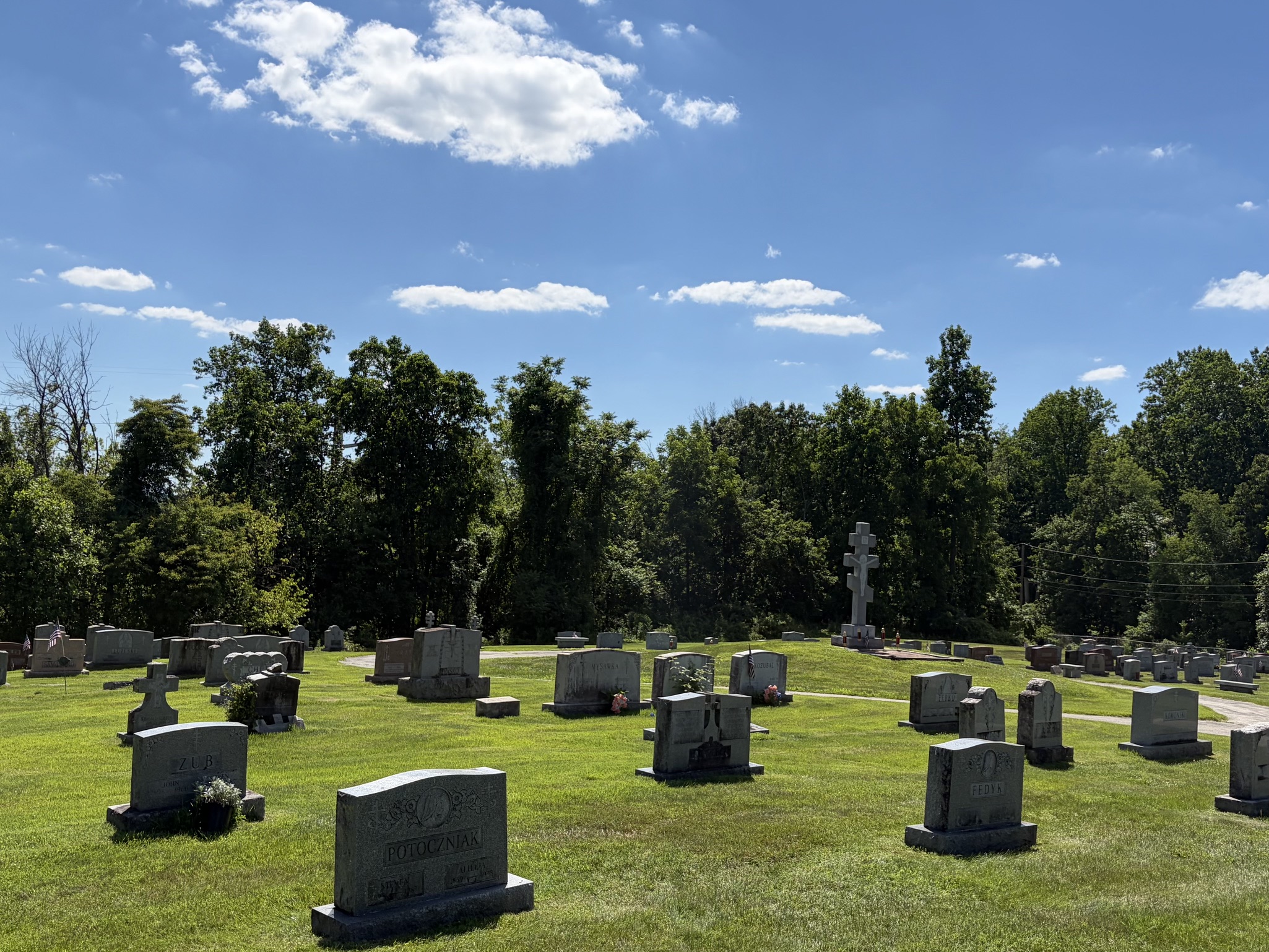
Mark Samilenko, president of Holy Ghost Orthodox Church in Phoenixville, which owns the cemetery next to the development site, said many parishioners were concerned about the potential impact of blasting on the property.
"We represent hundreds of families — people who are currently active and have plots up there and have loved ones up there," Samilenko told the board, adding that there are also graves of people who no longer have family affiliated with the parish. "But we represent them, and we are the caretakers."
Samilenko said creating a record of the cemetery's existing condition would be difficult because of the large number of graves, raising concerns about any potential damage claims in the future. He added that the church also has concerns about a well located at the cemetery.
Board Chair Stevens shared those concerns, saying she did not believe there was enough information to ensure blasting would not damage nearby homes or the cemetery.
The developer's representatives said seismographs would continuously monitor ground vibrations during blasting, allowing contractors to adjust explosive charges in real time. If wells or structures are damaged, affected property owners could work with the blasting contractor's insurance carrier to pursue claims.
"You say it's controlled, but it's still explosive," Stevens said.
Stormwater Concerns
Supervisor Tom Yeager repeatedly questioned whether the project’s stormwater basin was designed for the increasingly intense storms the region has experienced in recent years, including the kind of flooding that devastated Mont Clare during Hurricane Ida in 2021. He expressed concern that overflow from the Lovers Lane development could worsen conditions for properties downhill toward the Schuylkill River.
The basin, roughly four feet deep at its berm, will include an emergency spillway and a level spreader system that filters water underground before releasing it. In an overflow scenario, water would sheet flow toward the same natural drainage direction the site already uses today, according to the developer's team.
Upper Providence’s engineer Jen Gutshall said the township's stormwater regulations are more stringent than the state's and that the project complies with both. She added that the basin is designed to handle a "100-year storm," meaning a storm with a 1 percent chance of occurring in any given year.
The developer’s team explained that under the approved plan, a homeowners association will own and maintain the retaining walls, stormwater basin, and other common facilities. The HOA will also be required to carry insurance and budget for financial reserves based on industry best practices and the expected lifespan of those facilities.
Addressing concerns about long-term maintenance, Sivertsen said the project's operations and maintenance agreement will give the township authority to enforce maintenance requirements. If the HOA fails to properly maintain the basin or other stormwater facilities, the township could require corrective action, perform the work itself if necessary, and recover the cost from the HOA.
Supervisor Bill Starling noted that the township's ordinances are designed to reduce stormwater impacts when land is developed, ideally creating a better stormwater management situation than prior to construction.
"Any piece of land that's developed, because of our ordinances, the rate of water flow off that piece of land will be less than before it was developed," Starling said. "That's just engineering. It's science. That's not guesswork, it's not feelings — it will be less."
While Yeager acknowledged the point, it was not enough to persuade him to support the project, as he and Stevens voted against approval. Vice Chair A. Maria Jones-Sadler paused for several moments before joining Starling and Supervisor Helene Calci in voting to approve the application, after the board had discussed its limited legal grounds for denial.
This article was generated with AI assistance. All content was reviewed, edited, and fact-checked by John McGuire.