Limerick Woman Seeks Kidney Donor While Finding Purpose in Family and Loss
JM
John McGuire
•
Published Apr 20, 2026 at 12:39 PM EDT (Updated Apr 20, 2026 at 12:40 PM EDT)
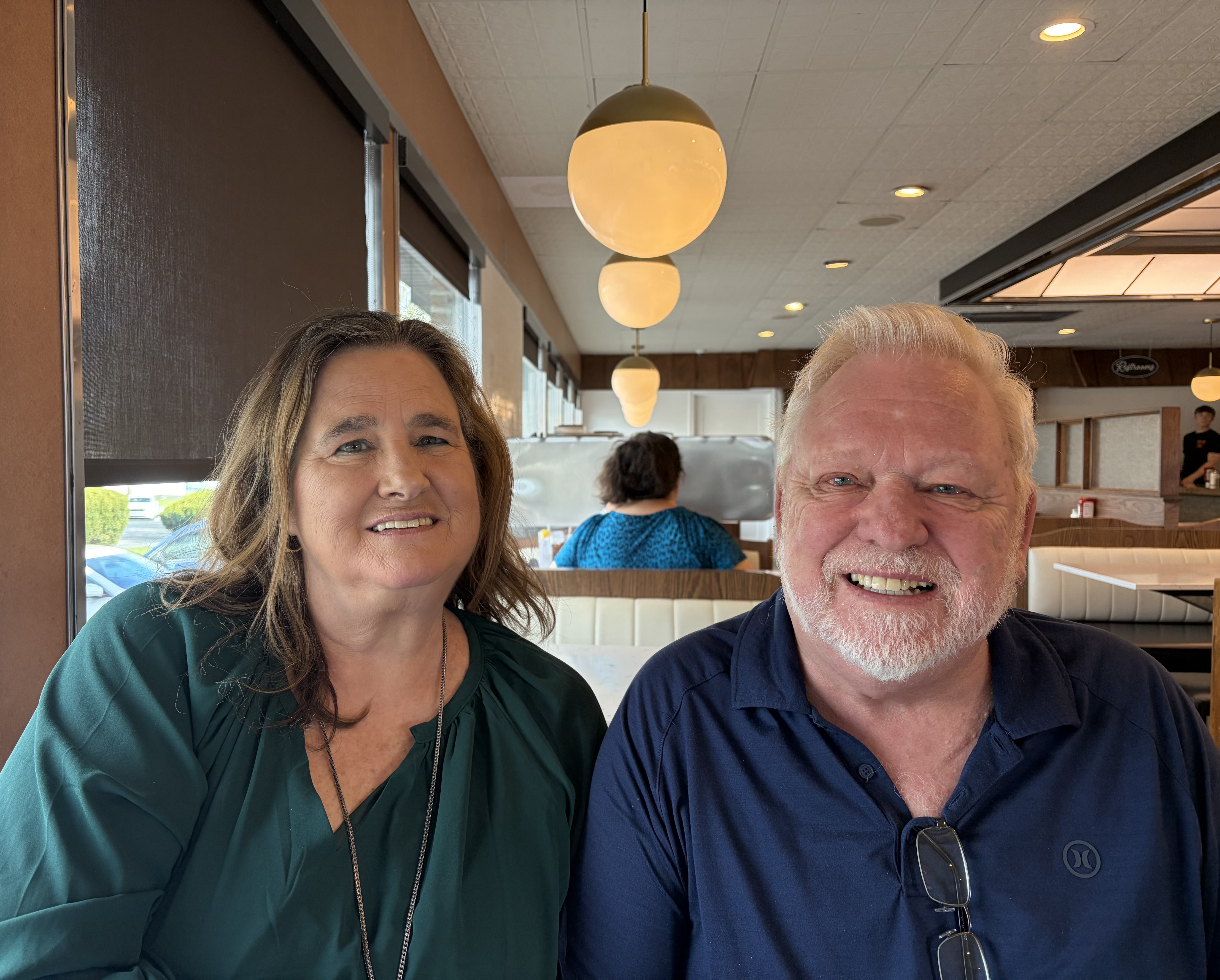
Teri and Chris Black discussed their story at the Limerick Diner.
Teri Black doesn’t like to think of it this way, but she knows it’s true.
Looking for a kidney donor, she said, can feel like a contest.
“There are thousands and thousands of people in the same situation,” said Teri, a longtime Limerick resident. “It shouldn’t feel like a competition, but it is.”
It’s a reality she’s faced more directly over the past year, as her chronic kidney disease progressed to the point where doctors told her she would need a transplant, or begin preparing for dialysis.
Turning 64 this year, Teri is now in the University of Pennsylvania's Transplant Program and has created an online profile through the National Kidney Registry, hoping to connect with a living donor. Without one, she could face a years-long wait for a deceased donor kidney, time that may be difficult to sustain as her condition advances.
A Long Road to This Point
Teri was first diagnosed with chronic kidney disease in 2017, already in Stage 3, with kidney function around one-third of normal.
Over time, those numbers steadily declined.
By last year, her kidney function had dropped to a level where transplant evaluation became necessary, which was a process that involved extensive testing before she was accepted into a transplant program. Today, her condition continues to progress, bringing fatigue, muscle loss, and the likelihood that dialysis will begin soon.
Dialysis, a treatment that filters waste from the blood when the kidneys can no longer do so effectively, can help extend life, but it also requires significant time, physical strain, and lifestyle adjustments.
A transplant remains the most effective long-term option.
How the Donation Process Works
For many people, kidney donation can seem complex or out of reach. Teri has made it a priority to explain how the process works — not just for herself, but for others in similar situations.
Potential donors typically begin with a basic screening, such as a blood test, followed by more detailed evaluations if they move forward. Costs are generally covered through the recipient’s insurance.
Not every willing donor is a match. But even those who aren’t can still help.
Through paired donation programs, a donor can give a kidney to another patient, allowing Teri to move up the transplant list through a coordinated exchange. Teri described how chains of donations can connect patients and donors across the system.
Her friend Jill Ferrera went through much of the testing process before ultimately being ruled out due to a pre-existing medical condition — a disappointment, but one Teri understands.
“They didn’t initially think it would be a problem, but they’d rather err on the side of caution,” she said. “And I’m okay with that.”
Teri’s life is not defined solely by her diagnosis.
In recent years, she has spent significant time supporting outreach efforts through Angels in Motion, a nonprofit that works with people struggling with substance use disorder. One of its initiatives includes assembling “blessing bags” — care packages filled with food, resources, and handwritten notes for people living on the streets.
The work is deeply personal.
In 2016, Black lost her oldest son, David, who died by suicide after years of battling addiction. He was 25.
“He was in recovery but struggling with it,” Black said. “Still today, I could not be prouder of him.”
A New Reason to Keep Going
More recently, Teri experienced something she once wasn’t sure would happen: becoming a grandparent.
“I have a grandchild now,” she said. “I never thought I’d have one.”
As the oldest, David was the one Teri expected would start a family first. Instead, that milestone came with her younger son Brian and his wife, Nadynne, who welcomed their son, Daniel David, about a year ago.
Her grandson has reshaped how she thinks about the future.
Teri talks about the everyday moments she hopes to share with Daniel — baking cookies, going to the pool, taking trips — the kinds of experiences she once had with her own children.
“I want to live,” she said.
For now, her condition limits what she can do. Fatigue and weakness make routine tasks difficult, including something as simple as carrying Daniel upstairs.
“I have a hard time remembering what it felt like to have that kind of energy,” she said. “I miss that.”
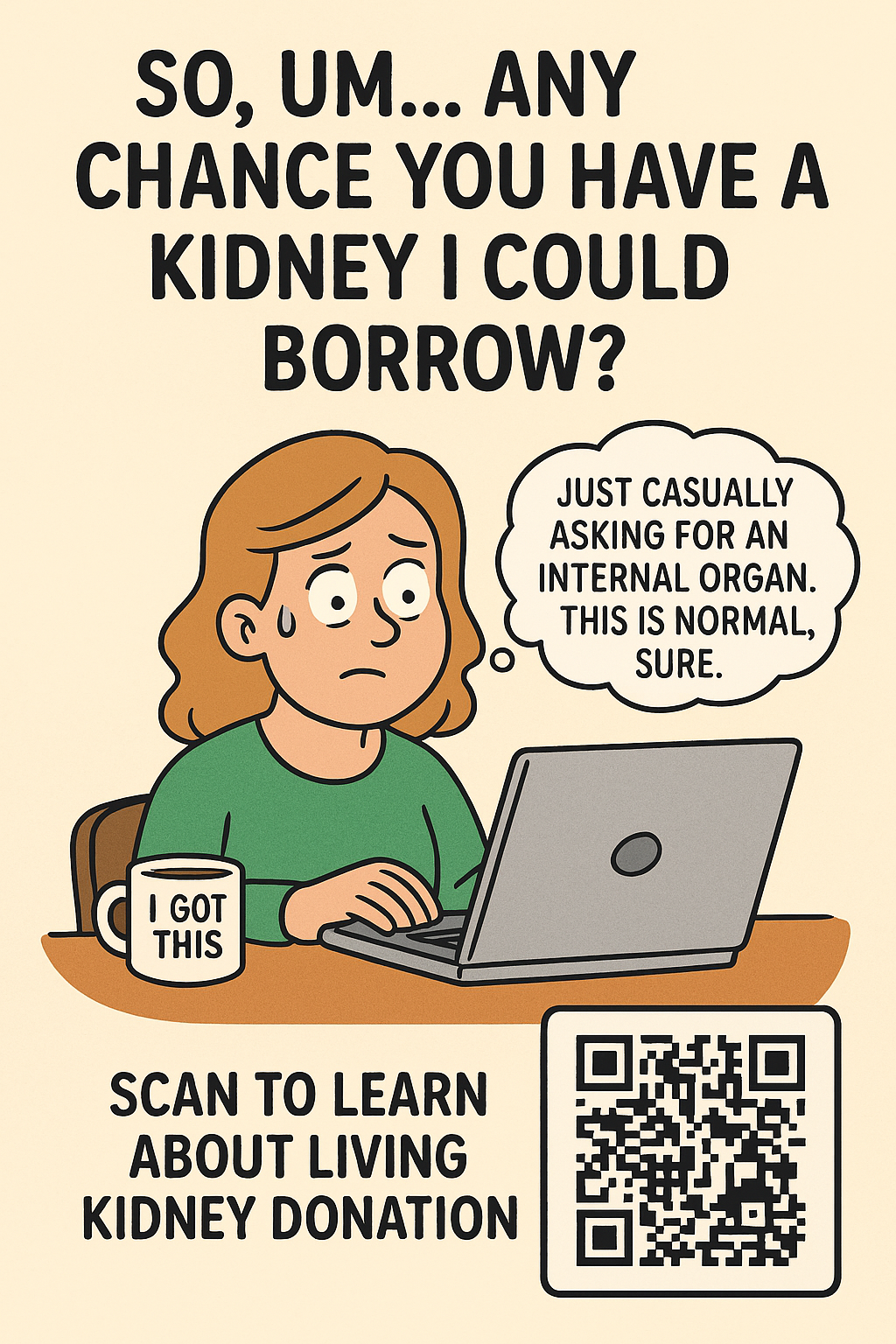
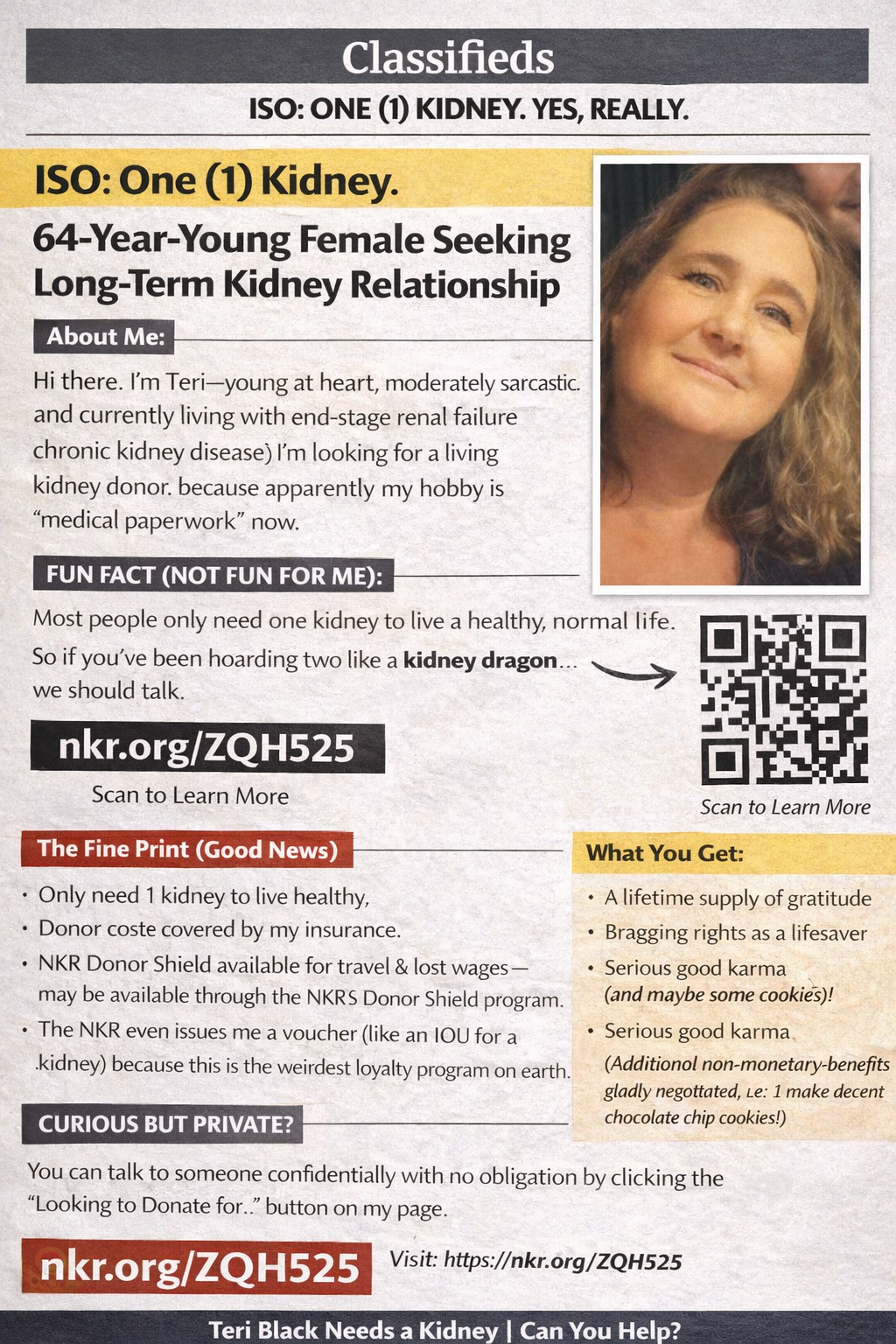
Teri Black designs her own marketing materials to help spread the word on social media.
A Partnership Built on Contrast
Through it all, her husband Chris Black, 80, has remained a steady presence.
The two met through their work in the biopharmaceutical field and have been together since 1999. Their personalities differ: Chris, a former researcher with a background in pharmacology, approaches the situation analytically, while Teri brings humor and spontaneity.
Chris focuses on diet, treatment options, and the medical details of her condition. Teri, meanwhile, has turned to social media — even creating a tongue-in-cheek “personal ad” graphic asking for a kidney, which gained traction online.
“I’ve still got some jokes to come up with,” she said, adding that she’s considered trying stand-up comedy about her experience.
Humor is part of how the couple copes.
“If I can make him laugh, like really laugh out loud, then that’s my win for the day,” Teri said of her husband.
Expectations, Rewritten
Their situation has also reshaped what they expected this stage of life to look like.
Chris, who is originally from England, had imagined they would be traveling — returning to Europe or taking cruises. Instead, they remain close to home, aware that a transplant call could come at any time.
“If you get that call, you need to be available,” Teri said.
Despite the shift in plans, they still find ways to keep things light.
“I just wanted her to look after me,” Chris joked, acknowledging their age difference. “Totally failed.”
“I don’t think that was in our wedding vows,” Teri added with a laugh.
Beyond One Story
Teri’s story reflects a broader reality: far more people need kidney transplants than there are available donors.
Many people live with early-stage kidney disease without realizing it. Others may not understand how living donation works, or how one person’s decision can help multiple patients.
At the same time, Teri is navigating the emotional difficulty of asking for help in a system where need far outweighs supply.
“I don’t want to be in a competition for a kidney,” she said. “Everyone is worthy. Everybody who needs a kidney has value.”
Still, she continues to share her story — balancing honesty, humor, and urgency — in hopes it reaches the right person.
Because for her, the goal is simple:
More time with her family. More time to give back. More time to live the life she’s still building.
When people tell her she’s strong, she laughs.
“They say God only gives you what you can handle,” she said. “And I think that God is trusting me way too much.”
To learn more about Teri's story, kidney donation, and how you can help, visit Teri's profile in the National Kidney Registry here.